
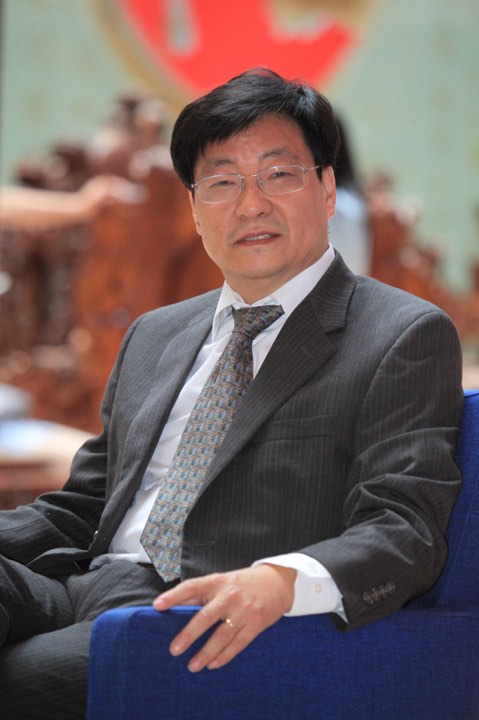
 |
Dean of FST |
Torch Relayed, Renewal Embraced — On Restructuring the Faculty of Science and Technology
By Xu Cheng-Zhong, Dean of the Faculty of Science and Technology (FST), University of Macau; Chair Professor of Computer and Information Science
Prologue — The Era Summons
In February 2019, I joined the University of Macau (UM) as the Faculty of Science and Technology (FST) marked its 30th anniversary — a moment when history and possibility converged. Over three decades of dedicated cultivation, FST has accomplished a historic transformation. From an initial role as an extension of Hong Kong’s higher education system, it has grown into a pillar of Macau’s autonomous higher education development, nurturing a large cohort of urgently needed science and engineering professionals for the Macau SAR. Today, 80% of Macau’s electromechanical engineers, 50% of its electronic engineers, and 25% of its registered civil engineers are graduates of FST. These figures are more than medals of honor earned through decades of service to Macau society – they are firm foundation upon which the Faculty’s future will be built. I carry deep pride in the FST’s enduring contributions to Macau’s economic and social progress.
Coinciding with UM’s relocation to its current campus, three State Key Laboratories, the State Key Laboratory of Analog and Mixed-Signal VLSI, the State Key Laboratory of Internet of Things for Smart City, and the State Key Laboratory of Mechanism and Quality of Chinese Medicine, were successively established. This marked a critical turning point for UM — a transition from a teaching-oriented university focused primarily on knowledge transfer into a research-oriented university embracing both knowledge transfer and innovation. Standing at the forefront of this transformation, FST delivered significant achievements in talent cultivation, scientific innovation, and social service. As a result, UM’s international standing rose significantly, entering the top 500 of the QS World University Rankings for the first time in 2019.
Technological innovation is not only essential to the moderate diversification of Macau’s economy; it is also a cornerstone of China’s national development strategy. In February 2019, the Outline Development Plan for the Guangdong-Hong Kong-Macau Greater Bay Area was released, explicitly calling for the development of an international center for science and technology innovation. The success of the development of the Greater Bay Area hinges on innovation — likewise the inevitable path for Macau’s sustainable economic diversification. It was against this historic backdrop that I joined UM and took on the responsibility of leading FST through its transformation. The era had summoned — and the time was ripe, yet the burden was great.
Growing Pains — Structural Flaws as the Starting Point of Self-Renewal
While fully recognized our achievements and opportunities, I was also keenly aware of the Faculty’s structural shortcomings and growing pains. At that time, although our physical infrastructure was adequate, a noticeable gap remained between us and leading research universities in terms of academic depth and substantive development:
First, the student structure was imbalanced. More than 55% of enrolled students were undergraduates, while PhD students accounted for only 18%. The overall quality and scale of doctoral training lagged behind that of peer research universities in the Greater Bay Area, limiting the Faculty’s ability to sustain high‑level research output.
Second, there was an imbalance of quantity over quality in knowledge innovation. While per-capita publication numbers were respectable, high-impact output remained insufficient. Papers published in JCR Q1 journals accounted for less than 50%, with few truly influential publications. Engagement with frontier interdisciplinary fields was limited, research activities were largely conducted in individual, and ross‑disciplinary collaboration mechanisms were underdeveloped..
Third, a culture of innovation had yet to be established. An internal ethos that genuinely values knowledge innovation had not taken root. Some faculty members were content with teaching alone, reflecting a mindset where “doing research or not, doing it well or poorly, made no difference.” Although an annual Full-time Academic Staff Performance Assessment (FAPA) system existed, it had become largely procedural, offering insufficient positive incentives for research excellence.
Despite favorable infrastructure and historical opportunity, it was clear that systemic self-reform in academic culture, talent structure, and evaluation mechanisms was imperative for the Faculty moving beyond the comfort zone of being teaching-oriented. Through seven years of collective effort, the Faculty achieved a profound leap from “knowledge dissemination only” to research-based teaching and learning.
Innovation Leads — Founding on Quality, Fortifying Through Renewal
Inheritance forms the foundation; innovation provides the driving force. While preserving the Faculty’s long-standing emphasis on talent cultivation and internationalization, we adhered to the principle of building the Faculty on quality and strengthening it through innovation — aligning development with global academic frontiers and integrating deeply into China’s national innovation agenda.
First, optimizing the disciplinary landscape. Anchored in the development of New Engineering combined with Artificial Intelligence, we actively responded to global technological trends and societal needs. Innovative master’s programmes were launched in Financial Technology, Internet of Things, Artificial Intelligence, Robotics and Autonomous Systems, Coastal Environment and Safety, Construction Project Management, Smart Ocean Technology, and Smart Power Grid — expanding our total number of master’s programmes from 19 to 27. In 2022, the Department of Ocean Science and Technology was officially established, further strengthening our disciplinary ecosystem and reflecting the Faculty’s proactive vision and commitment to serving Macau’s long-term development.
Second, focusing on substantive development and rebuilding academic benchmarks through high-quality output. After seven years of sustained effort, the Faculty has achieved a remarkable performance: the proportion of JCR Q1 publications exceeded 75%; output in top-tier computer science conferences progressed from zero to a level projected to enter the global ranking top 100 by 2025 among leading institutions in the Greater Bay Area; six new faculty members were elected as Fellows in their respective professional fields; the number of scholars listed among the world’s top 2% of scientists increased from 15 to 37; and a cohort of faculty members received prestigious awards including the State Scientific and Technological Progress Award, the Guanghua Engineering Science and Technology Award and the Xplorer Prize. In 2024, FST faculty accounted for 45% of all recipients of the Macau SAR Government Science and Technology Awards, highlighting our deep cultivation in research and teaching. Notably, nine young professors have been awarded the National Natural Science Foundation of China (NSFC) Excellent Young Scientists Fund (Hong Kong and Macau). In recent years, we have also cultivated five NSFC Excellent Young Scientists (Overseas), who have taken up positions at leading universities in Mainland China.
These robust metrics witness the simultaneous improvement in both the scale and quality of the Faculty’s research competitiveness. Our international recognition has also accelerated accordingly : Engineering and Computer Science have entered the top 0.1% globally in ESI rankings for the first time; both fields advanced to the 101–125 bracket in the THE World University Rankings by Subject; and in the U.S. News & World Report and Shanghai Ranking’s Global Ranking of Academic Subjects, disciplines such as Electrical and Electronic Engineering, Artificial Intelligence, and Computer Science have successfully entered the global top 100, ranking among the best in the Greater Bay Area.
Trinity in One – A Collaborative Innovation of Talent, Platforms, and Mechanisms
These accomplishments stem primarily from a synergistic ‘talent–platform–mechanism’ development framework that underpins our innovation ecosystem. Talent defines the frontier of originality, platforms strengthen capacity, and mechanisms ensure quality and sustainability. Together, these elements continue to foster an academic environment that values excellence, intellectual depth, interdisciplinarity, and growth — driving sustained and accelerated development in research output, talent cultivation, and societal impact.
Talent. People are the driving force of knowledge innovation, and professors’ innovative mindset and scholarly excellence directly shape the quality of research outcomes and talent cultivation. What I am most proud of is that over the past few years, we have recruited more than 70 outstanding professors. Nearly all newly appointed faculty hold PhDs or have postdoctoral experiences from top overseas universities. Assistant professors from world-class institutions like MIT, Stanford, UC Berkeley, Cambridge, and ETH are no longer exceptions but are increasingly becoming the norm. Benchmarking their research against international excellence, these scholars bring fresh perspectives from the global academic frontier and serve as vital bridges connecting us with the international research community.
Platforms: Advanced research platforms play a decisive role in attracting top talent — particularly those positioned at the frontiers of scholarship and at the intersections of disciplines, where they play a “nest‑building” role in drawing outstanding scholars. FST supported the establishment of the State Key Laboratory of Analog and Mixed-Signal VLSI. When I joined UM, the State Key Laboratory of Internet of Things for Smart City and the Institute of Collaborative Innovation (ICI) were just being launched. Aligning with university-level strategy, the Faculty actively participated in building interdisciplinary and collaborative innovation research platforms spanning power electronics, computer science, AI, and civil and environmental engineering. To further promote interdisciplinary integration, since 2018, FST has taken the lead in establishing research centers in AI and Robotics, Regional Oceans, Data Science, and Applied Mathematics — fostering interdisciplinary collaboration between science, technology, and the humanities to harness collective innovative intelligence.
Notably, platforms also play an irreplaceable role in attracting international talent. For instance, among the 12 professors recently recruited by the ICI’s Center for Cognitive and Brain Sciences, more than half are non-Chinese scholars from countries including the United States, the United Kingdom, Germany, and France. These internationally diverse teams are drawn to UM precisely because of the strength of its platforms, opening new opportunities for future global collaboration. In addition, the newly established Center for Regional Oceans has become an important cooperation platform linking UM with marine research communities in Lusophone countries.
Beyond talent attraction, platforms also help secure more resources to support collaborative innovation research. After joining UM, leveraging the State Key Laboratory of Internet of Things for Smart City, I served as the principal investigator for three major research projects, each valued at ten million. These include a key R&D project on “Smart Cities” funded by China’s Ministry of Science and Technology, a Guangdong Province key R&D project on “Intelligent Management and Control of Cloud Data Centers,” and a research initiative on “Intelligent Driving Technologies” supported by the Macau Science and Technology Development Fund (FDCT). Working closely with leading domestic universities and industry front‑runners, we have pursued joint research breakthroughs that not only delivered “UM solutions” for real‑world technological deployment but have also significantly enhanced the University’s academic standing and influence within China’s innovation ecosystem.
Mechanisms: Talent and platforms are mutually reinforcing, much like seeds and soil. Yet even the best seeds cannot germinate and thrive without innovative mechanisms to nurture their growth. While UM had long maintained an annual FAPA assessment mechanism, it had gradually become procedural in nature. One of my first initiatives upon joining UM was to lead the Faculty in redesigning the FAPA assessment model, lowering the Faculty’s average score from 9 to 7 to differentiate performance more clearly, establish benchmarks of excellence, and ensure that high achievers received appropriate recognition and meaningful incentives. We introduced special rewards for faculty members achieving “first breakthroughs” within their disciplines, encouraging a step‑by‑step approach toward publishing in top journals and conferences — rather than pursuing overly ambitious goals disconnected from sustainable academic growth.
Simultaneously, we emphasize that academic publications are not the sole pathway to knowledge innovation. Adhering to a problem‑oriented mindset and the principle that application creates value, we actively encourage faculty members in engineering and technology fields to engage more deeply with industry, particularly leading enterprises. Some faculty members have gone further by arranging for students to participate directly in technology transfer and commercialization efforts, exploring alternative innovation pathways through which technology can better serve industry and society. Starting in 2025, FST has formally recognized and commended hybrid talents who demonstrate excellence in both original research and technology transfer.
Today, FST has cultivated a virtuous ecosystem that respects knowledge innovation and champions high-quality research. This represents the most significant breakthrough in the Faculty’s development in recent years. Over the past seven years, we have not only carried forward the torch of academic tradition but also forged a distinctive, UM‑characteristic pathway for building an innovative, research‑oriented faculty.
Galaxy of Stars – A Glimpse of Glorious Achievements
As a comprehensive faculty, FST has achieved remarkable accomplishments across a wide range of disciplines. While research outputs from the two State Key Laboratories have already received extensive media coverage, I would like to spotlight notable achievements in several other fields instead.
Mathematics: In the field of Mathematics, Chair Professor Gui Changfeng of the Department of Mathematics achieved breakthrough results on the best constant problem of the Moser-Trudinger inequality and the existence of solutions to critical exponent elliptic equations — resolving several renowned mathematical challenges, including the Aubin conjecture, with profound theoretical implications. He published four significant papers in world-leading journals such as Inventiones Mathematicae and Journal of the European Mathematical Society, marking a historic breakthrough by achieving Macau’s first publications in the “Big Four” top mathematics journals.
Engineering Sciences: In engineering sciences, Assistant Professor Zhong Junwen of the Department of Electromechanical Engineering focuses on intelligent micro‑electromechanical systems (MEMS), with micro-robots and flexible electromechanical devices as his main research targets. He has achieved outstanding results, including the development of a highly agile electronic insect, published in Science Robotics — marking the first paper by a Macau scholar in this top-tier journal. His flexible tactile sensing and feedback devices enable long-distance tactile transmission and can be applied to near-realistic online human-machine interaction. He has recently received funding from the National Natural Science Foundation of China’s Excellent Young Scientists Fund.
Computing Technology: In computing technology, Assistant Professor Xu Huanle of the Department of Computer and Information Science specializes in cloud-native architecture and large-model infrastructure optimization. He pioneered a shared microservice resource management scheme in Alibaba’s large-scale cloud service environments, achieving savings of over 50% in computing resources. Addressing Agentic AI, he was the first to realize a post-training system with shared cache prefixes, reducing model training time by 50%. These achievements have been integrated into Huawei’s large-model training engine.
AI + Health: In the AI + Health domain, Chair Professor Cai Xiaochuan, with joint appointments in the Department of Mathematics and Computer Science, has long been devoted to interdisciplinary research in AI and healthcare, with particularly distinguished achievements in medical image analysis and intelligent diagnosis. Leveraging big-health technologies that integrate AI and high-performance computing (HPC), his team has achieved tangible clinical outcomes in areas such as basic research and clinical diagnosis of cardiovascular and cerebrovascular diseases, fundamental computation for arrhythmia and electrocardiography (ECG), and digital diagnosis of liver and kidney diseases. The team has also developed a mixed-reality-based virtual diagnostic system that significantly enhances clinical efficiency and can be applied to personalized medicine, preoperative planning, and remote multi-center consultations for complex cases — yielding significant social and economic benefits.
Technology Transfer: In technology transfer, Associate Professor Hao Tianwei of the Department of Civil and Environmental Engineering has made groundbreaking advances in wastewater treatment and high-value resource recovery from sewage sludge. Traditionally regarded as an environmental burden, wastewater and residual sludge have been transformed by Prof. Hao into “green treasures.” On one hand, he developed a novel new low-carbon wastewater treatment process that drastically reduces energy consumption; the accompanying innovative biological carrier fillers have been successfully implemented in a wastewater treatment plant in Heilongjiang and have withstood the challenges of operation in cold northern climates. On the other hand, he achieved the high-value monetization of sludge, with recovered resources now being widely applied in aquaculture across the Yangtze River Delta and Pearl River Delta regions.
These outstanding achievements not only demonstrate the status and influence of FST within the Greater Bay Area and the international academic community but also directly respond to national development strategies and Macau’s need for appropriate diversified economic development — fully showcasing the sense of responsibility and commitment of UM’s scientific community.
Break to Rebirth – Advancing Restructuring with Order and Grace
The restructuring of the Faculty is not merely an adjustment to administrative organization; it is a structural transformation aimed at deepening disciplinary positioning and invigorating institutional vitality. Throughout the process, we have adhered firmly to the principles of top-level design, smooth transition, and quality first — focusing on preparatory works in three main areas:
First, optimizing top-level disciplinary design to build an internationally aligned academic structure
FST encompassed fifteen first-level disciplines listed in the Ministry of Education’s subject catalog, resulting in a very large organizational scale. Following restructuring, the functional positioning of the Faculty of Science (FSC), the Faculty of Engineering (FEG), and the Faculty of Information Science and Computing (FIC) has become clearer and more precisely defined. In particular, the naming of FIC draws on the “Computing” paradigm adopted by leading institutions such as MIT and Stanford. Taking into account Macau’s local context, it is named “Information Science and Computing” — encompassing both software and hardware information technologies related to computing, while achieving a balanced integration of international perspective and local characteristics.
In terms of programme development, building on the original 29 programmes of FST, FIC added undergraduate programmes in Artificial Intelligence, Electronic and Communication Engineering, Microelectronics, Robotics, and Financial Technology. FEG retained core programmes in Electrical and Computer Engineering (ECE), Electromechanical Engineering (EME), Civil and Environmental Engineering (CEE), and Ocean Science and Technology (OST), while adding new undergraduate programmes in Biomedical Engineering and Materials Science and Engineering. FSC, building on its established strengths in Mathematics, Physics and Chemistry, introduced a Biology programme, while further differentiating and reorganizing the Physics and Chemistry programmes. Correspondingly, six departments were established in both FIC and FEG, and four departments in FSC. This configuration is designed to allow each disciplinary direction to develop with focus and precision within its own dedicated track.
Second, reconstructing the talent cultivation system to break barriers and promote interdisciplinary integration
In curriculum and programme design, we adopted a strategy of “parallel advancement of new and existing programmes with cross-disciplinary innovation”. Newly established programmes such as AI and Biomedical Engineering are directly aligned with the construction of new departments. For traditional programmes such as ECE and EME, we moved beyond the conventional model of management by a single department and instead implementing cross-faculty and cross-department co-construction mechanisms. This institutional innovation aims to dismantle disciplinary silos, enabling students to grow within a fertile interdisciplinary environment and truly cultivate composite and versatile talents. Meanwhile, quality assurance mechanisms have been strengthened in parallel. We are actively engaging with the Hong Kong Institution of Engineers (HKIE) to advance professional accreditation for emerging disciplines such as Biomedical Engineering and AI, thereby ensuring the international recognition and competitiveness of our degrees.
At the same time, in terms of research platform positioning, we have proactively restructured the Institute of Collaborative Innovation (ICI) and established the Institute of Artificial Intelligence and Brain Science (IAIBS), positioning ourselves at the forefront of the deep integration between artificial intelligence and brain science. Leveraging the unique advantages arising from this interdisciplinary convergence, the institute focuses on human–machine interaction, applies insights from brain science to inspire intelligent system design, and builds a forward‑looking, multi‑disciplinary collaborative innovation platform. This initiative further strengthens UM’s role as a strategic academic anchor, contributing to Macau’s development as an international hub for high‑level talent and advanced technological achievements.
Finally, we have steadily advanced faculty realignment and new campus expansion to ensure coordinated operation across two campuses In faculty adjustment — one of the most critical aspects of restructuring — we established the principle of “primary appointment in one department, with concurrent appointment across disciplines”. This approach ensures clear academic affiliation for faculty members while encouraging interdisciplinary collaboration through joint appointments. At present, a number of courses are being successfully delivered at the temporary Hengqin teaching site, with more courses scheduled to relocate there in the coming autumn. For popular postgraduate courses, we have introduced an innovative “two campuses, same faculty, same quality” teaching model — carefully coordinating teaching assignments so that the same instructors deliver courses across locations, ensuring that students at both campuses have equal access to high-quality educational resources.
The division and restructuring of the Faculty is a systematic and comprehensive endeavour. We sincerely thank all faculty members and students for their understanding and support. We are confident that through this restructuring, we will further unleash disciplinary vitality and lay a more solid institutional foundation for the long-term development of UM’s science and engineering disciplines.
Epilogue — On to the New: A Vision of Excellence Ahead
The division and restructuring of FST marks a pivotal step in UM’s transition from quantitative growth to a qualitative leap — and represents an inevitable pathway toward institutional excellence.
After nearly a decade of rapid development, the Faculty has undergone a profound transformation in scale and capacity. The academic staff has doubled to 180 members, while the number of PhD students has exceeded 1,100, with an average of seven PhD students per supervisor — a ratio that substantially surpasses the conventional upper limit of comparable international research universities. While the original “mega-faculty” structure played an important historical role, it has become increasingly difficult for such a model to accommodate emerging trends in frontier science and interdisciplinary research, thereby constraining deeper disciplinary advancement. The current restructuring offers a valuable opportunity for both expansion and upgrading. Through more targeted development and precise efforts, we can further strengthen our faculty, optimize the disciplinary ecosystem, and truly build the University of Macau into a comprehensive, internationally competitive research university.
Opportunities, however, are inseparable from challenges. The relocation of FIC and FEG to the Hengqin Cooperation Zone is not merely a change of physical location; it signifies a fundamental reshaping of our development paradigm. The key question before us is how to move beyond the stage of “rooted in Macau and reaching toward the Greater Bay Area” and advance toward the more demanding goal of deep integration into the national innovation system. This requires not only overcoming the “last mile” challenges of translating research into practice but also proactively constructing a closed-loop innovation ecosystem that tightly integrates industry, academia, research, and application — directly serving the core needs of the moderate diversification of the Macau-Hengqin economy.
The spirit of “seeking truth and being pragmatic, while pioneering and innovating” — forged over more than three decades of development — is the most precious asset underpinning the steady and sustainable progress of the newly established faculties. “Seeking truth and being pragmatic” defines the foundation of our academic ethos; regardless of structural changes, our commitment to rigorous scholarship and service to society remains unwavering. “Pioneering and innovating” provides the impetus for continual advancement. As Macau aligns its 3rd Five-Year Plan with the national 15th Five-Year Plan, the Government’s 2026 policy agenda places higher expectations on the integrated, high-quality development of education, technology, and talent. Meeting these expectations calls for greater resolve in advancing the development of an international higher‑education hub and fostering technology‑driven industries.
Beyond the window, dawn is breaking in the east. A new day is unfolding, and a new journey is about to begin. Let us cherish the achievements of the past and welcome the sunrise of tomorrow with confidence and determination.
I firmly believe that, through the collective efforts of all faculty members and students, we will live up to our mission, carry forward our legacy, and build the science and technology arm of UM into a globally influential center of education, research, and innovation — a source of pride for the people of Macau. In doing so, we will contribute “UM’s strength” to the scientific and technological self-reliance of the Greater Bay Area and the nation at large.
May the three new faculties flourish, may UM continue to thrive, and may the seeds of science and technology planted here grow, blossoming into ever more brilliant achievements.
Dean of FST
Cheng-Zhong XU
薪火相傳 向新而生——寫在科技學院拆分重組之際
序章:時代的召喚
2019年2月,我加入澳門大學,適逢學院成立三十周年。三十載耕耘,學院完成了從早期作為香港教學的補充,到澳門高等教育自主發展的歷史性跨越,為特區建設培養了大批急需的科技人才。澳門80%的機電工程師、50%的電子工程師以及25%的注冊土木工程師來自澳門大學科技學院。這些沈甸甸的數字,不僅是服務澳門社會的歷史勳章,更是學院未來發展的堅實根基。我為學院對澳門經濟社會發展的歷史性貢獻深感自豪。
伴隨學校遷址橫琴,模擬與混合信號集成電路、智慧城市物聯網、中藥機制與質量三個全國實驗室相繼落地,大學迎來了從以“知識傳授”為主的教學型大學,向“知識傳授與創新並重”的研究型大學轉型的關鍵契機。科技學院勇立潮頭,在人才培養、知識創新和社會服務等方面開展了卓有成效的工作,取得累累碩果。學校的國際排名也嶄露頭角,2019年QS排名首次進入前500名。科技創新不僅是澳門經濟適度多元化的需要,更是國家發展戰略的重要一環。2019年2月,《粵港澳大灣區發展規劃綱要》公布,明確提出“建設國際科技創新中心”的目標。推動大灣區建設,關鍵在創新,這也是澳門經濟適度多元化的必由之路。我有幸在這樣的時代背景下加入澳大,帶領科技學院實現轉型,可謂適逢其時,也深感責任重大。
第一章:成長的陣痛——結構性短板與自我革新的起點
在看到成績與機遇的同時,我也清醒地認識到學院的“結構短板”與“成長陣痛”。彼時,雖硬件條件尚可,但在內涵建設上與一流研究型大學仍有差距:
第一,學生結構失衡。 在讀學生中超過55%是本科生,博士生占比僅為18%,博士生質量也差強人意,與大灣區其他研究型大學差距較大,難以支撐高水平科研產出。
第二,知識創新“量多質少”。 雖人均論文數量尚可,但高水平產出不足,JCR一區論文占比不到50%,少有高質量、有影響力的論文發表。前沿交叉學科鮮有涉獵,絕大部分科研項目是單兵作戰,跨領域協同創新機制尚不成熟。
第三,創新文化尚未確立。 學院內部崇尚知識創新的氛圍有待形成,部分教師滿足於知識傳授,存在“科研做與不做一個樣、做好做壞一個樣”的現象。雖有FAPA年度考核機制,但流於形式,對優秀研究人員缺乏正向激勵。
我們雖有較好的硬件條件和時代機遇,但必須在學術文化、人才結構和評價機制上進行一場自我革新,才能讓學院走出“教學型”的舒適區。經過七年的共同努力,我們實現了從“教學立本”到“創新引領”的深刻跨越。
第二章:創新引領——以質量立院,以創新強院
傳承是基礎,創新是動力。在傳承學院“人才培養”與“國際化”理念的基礎上,我們堅持“以質量立院,以創新強院”,將學院發展對接國際學術前沿,深度融入國家創新發展大局。
首先,優化學科布局。 我們以建設“新工科+人工智能”為抓手,積極回應全球科技發展趨勢與社會需求,陸續推出金融科技、物聯網、人工智能、機器人與自主系統、海岸帶環境與安全、建造項目管理、智慧海洋技術、智能電網等創新碩士學位專業,使學院專業從原來的19個發展到27個。2022年,新設立海洋科學及技術系,進一步完善了學科生態,體現了學院面向未來、服務澳門的積極擔當。
其次,聚焦內涵建設,以“高質量產出”重塑學術標桿。 經過七年努力,我們交出了一份令人振奮的成績單:JCR一區論文占比達到75%以上;計算機領域頂級會議論文從無到有,位列粵港澳大灣區大學前列,2025年世界範圍排名進入百強;6位新同事當選各自領域的Fellow;全球前2%頂尖科學家榜單從最初的15位躍升至37位;一批教授獲頒“國家科技進步獎” 、“光華工程獎”、“科學探索獎”等重要獎項。2024年度,澳門政府頒發的科學技術獎中,科技學院教師占比達45%,彰顯了學院深耕科研與教學的成果。特別令人欣慰的是,9位年輕教授獲國自然優秀青年科學基金項目(港澳)資助。近年也培養了5位海外優青,他們已回內地一流大學工作。
這些硬核數據,見證了學院科研競爭力的量質齊升。相應的國際聲譽也節節攀升:工程學與計算機科學兩個領域的ESI排名首次進入0.1%的頂尖學科行列;THE世界大學學科排名中,工程科學與計算機科學同步升至101-125名;《美國新聞與世界報道》和上海軟科世界一流學科排名中,電子與電氣工程、人工智能、計算機科學等成功躋身全球百強,位列粵港澳大灣區前列。
第三章:三位一體——人才、平台、機制的協同創新體系
這些成績的取得,主要得益於“人才、平台、機制”三位一體協同發展理念與相互增益的創新體系。人才決定原創性的高度,平台提升承載力,機制保障質量與可持續發展。三者協同,持續營造“重質量、有品味、可交叉、利成長”的學術環境,推動學院在科研產出、人才培養與社會服務上實現可持續加速發展。
【人】 知識創新的主體是人,教授的創新思維與素養直接影響研究成果與人才培養質量。令我最自豪的是,過往幾年我們招攬了70多位優秀教授。幾乎所有新進教授都有海外頂尖名校博士或博士後經歷,來自MIT、Stanford、UC Berkeley、Cambridge、ETH等學校的助理教授已不再是特例,而是正在成為常態。他們的研究對標國際一流,帶來了國際學術前沿的新視角,更起到對接國際的橋梁和紐帶作用。
【平台】 吸引人才的重要手段是平台,特別是學術前沿和交叉領域的平台,起到“築巢引鳳”的作用。學院協助成立了模擬與混合信號集成電路全國重點實驗室。我加入澳大時,適逢智慧城市物聯網全國重點實驗室和協同創新研究院(ICI)平台剛剛啟動。我們配合大學戰略布局,積極參與平台建設,打造跨電力電子、計算機、人工智能、土木與環境工程等領域的協同創新研究平台。為進一步促進跨學科融合,科技學院自2018年起主導成立人工智能與機器人、區域海洋、數據科學、和應用數學等研究中心,希望通過科技與人文的交叉融合,凝聚創新智慧。
值得一提的是,平台在招聘國際化人才方面也發揮不可替代的作用。例如,ICI認知與腦科學研究中心新近招聘的12位教授中,超半數為非華裔學者,來自美、英、德、法等國。國際化的團隊為平台而來,為澳大未來發展提供了國際化合作的新機遇。此外,新成立的區域海洋研究中心也成為聯系葡語國家海洋研究的重要合作平台。
平台吸引人才,也有助於吸引更多資源支持協同創新研究。我加盟澳大後,利用智慧城市物聯網全國實驗室平台,以項目負責人身份,牽頭承擔了三個千萬元級科研項目,包括國家科技部“智慧城市”重點研發項目、廣東省“雲數據中心智能管控”重點研發項目以及澳門科技基金FDCT“智能駕駛技術”研究專項。我們與多家國內頂尖大學和頭部企業合作,聯合攻關,不僅為相關技術落地提供了“澳大方案”,也提升了大學在國內業界的學術地位和影響。
【機制】 人才與平台相輔相成,如同種子與土壤。種子發芽成長離不開創新的機制保障。澳大原有FAPA年度考核機制,但以往流於形式。我來澳大後的第一件事,就是帶領學院重構FAPA考核公式,將學院均分從9分降到7分,拉開差距,樹立標桿,讓優秀者得到應有的尊重與激勵。我們對各學科“首篇突破”的教師進行特別獎勵,引導教師循序漸進沖擊頂刊頂會,而非好高騖遠。
同時,我們強調論文發表不是知識創新的唯一途徑。堅持問題導向、應用創造價值的理念,鼓勵技術領域教師多與業界特別是頭部企業合作。有的教師安排學生直接參與成果轉化工作,為科技服務產業探索不一樣的創新之路。2025年起,學院對在原創研究和成果轉化兩方面表現突出的覆合型人才加以表彰。
如今,科技學院已形成尊重知識創新、爭做高質量研究的良性生態。這應該是近年科技學院發展的最大突破。我們用七年時間,不僅傳承了薪火,更走出了一條具有澳大特色的研究型學院創新之路。
第四章:群星閃耀——代表性成果巡禮
作為一個綜合性學院,科技學院在各方面取得令人矚目的成績。依托兩個全國重點實驗室的研究成果媒體報道較多,此處不贅述。我想特別提及其他領域的亮點:
數學領域: 數學系講座教授桂長峰在Moser-Trudinger不等式最佳常數問題及臨界指數橢圓方程解的存在性等方面取得突破性成果,解決了著名的Aubin猜想等重要數學難題,具有深遠的理論影響。他在國際頂尖雜志《數學新進展》《歐洲數學會通訊》發表4篇重要論文,實現了澳門在數學四大頂刊零的突破。
工程科學領域: 機電工程系助理教授鐘俊文圍繞智能微機電系統,以微型機器人與柔性機電器件為研究對象,做出傑出成果。他研制的高敏捷電子昆蟲發表於 Science Robotics,是澳門學者在該頂級期刊的首篇論文;開發的柔性觸覺感知與反饋器件實現遠距離觸覺傳遞,可應用於近真實在線人機交互。最近獲國家優青項目資助。
計算技術領域: 電腦及資訊科學系助理教授徐歡樂專注於雲原生架構與大模型基礎設施優化研究。他在阿里巴巴大規模雲服務場景中首創共享微服務資源管理方案,可節省50%以上計算資源;針對Agentic AI首次實現共享緩存前綴的後訓練系統,可將模型訓練時長縮短50%,成果已集成至華為大模型訓練引擎。
AI+健康領域: 數學系與計算機系講座教授蔡小川長期致力於人工智能與醫療健康的交叉研究,尤其在醫學圖像分析與智能診斷領域成果卓著。基於AI與HPC融合的大健康技術,在心腦血管疾病基礎研究及臨床診斷、心律失常與心電圖基礎計算、肝臟及腎臟病數字診斷等方面取得臨床實效。團隊開發的基於混合現實的虛擬診斷系統顯著提升臨床效率,可應用於個性化醫療、術前規劃與疑難雜癥遠程多中心會診,具有顯著社會與經濟效益。
成果轉化領域: 土木及環境工程系副教授郝天偉在污水處理與污泥高值資源化領域取得突破性進展。過去,污水和剩餘污泥往往被視為城市的環保負擔,但郝教授將其變為“綠色寶藏”。一方面,開發新型低碳污水處理工藝,大幅降低能耗,配套的新型生物載體填料在黑龍江某污水廠實現工程落地,經受住了北方寒地運行考驗。另一方面,實現污泥高價值變現,從污泥中回收的高價值資源已在長三角和珠三角水產養殖中推廣應用。
這些傑出成果不僅證明科技學院在粵港澳大灣區乃至國際學術界的地位和影響,更是對國家戰略和澳門經濟適度多元化需求的直接響應,展現了澳大科技工作者的擔當。
第五章:分而新生——平穩有序推進拆分重組
學院拆分重組不僅是行政管理架構的調整,更是一場深化學科布局、激發辦學活力的結構性變革。我們始終堅持“頂層設計、平穩過渡、質量為先”的原則,主要開展了三方面準備工作:首先,優化學科頂層設計,構建與國際接軌的學科架構。 科技學院涵蓋教育部學科目錄中的15個一級學科,體量龐大。重組後,理學院、工學院及信息學院的職能定位更加清晰精準。特別是FIC的命名,參考了MIT、Stanford等頂尖學府“Computing”的模式,結合澳門實際,定名為“Information Science and Computing”,既涵蓋計算相關的軟硬件信息技術,又實現了國際視野與本土特色的有機融合。
在學科建設方面,我們在科技學院原有29個專業基礎上,於信息學院(FIC)增加AI、電子與通信、微電子、機器人和金融科技等本科專業;工學院(FEG)繼承電子與計算機工程(ECE)、機電工程(EME)、土木及環境工程(CEE)及海洋科學技術(OST)專業,增加生物醫學及材料科學與技術本科專業;理學院(FSC)在原有數學與物理化學基礎上,增加生物專業,並拆分物理與化學專業。相應地在FIC和FEG各成立6個系,FSC成立4個系對接。這一布局旨在讓每個學科方向在專屬賽道上精準發力。
其次,重構人才培養體系,打破壁壘促進交叉融合。 在課程與項目設置上,采取“新舊並舉、交叉創新”策略。對於人工智能、生物醫學工程等新設項目,直接對應新學系建設;對於傳統的ECE和EME項目,打破傳統“單一院系包辦”模式,實行跨學院、跨學系共建。這種機制創新旨在打破學科壁壘,讓學生在交叉學科沃土中獲得更廣闊的成長空間,真正培養覆合型人才。同時,質量保障同步跟進,我們正積極與香港工程師學會對接,推動生物醫學工程、人工智能等新學科的認證工作,確保學位國際認可度。
最後,穩步推進師資調整與新校區拓展,確保雙校區協同運行。 在師資調整這一核心環節,確立“主聘一系、兼聘交叉”原則,既保障教師明確學術歸屬,又通過兼任聘任機制鼓勵跨學科合作。目前,部分課程已在橫琴臨時辦學點順利開展,今秋將有更多課程進駐。針對研究生熱門課程,創新推行“雙校區、同師資、同質量”教學模式,合理安排同一教師授課,確保兩個校區學生享受同等優質教育資源。
拆分重組是一項系統工程。感謝全院師生的理解與支持,我們有信心通過這次重組,進一步釋放學科活力,為澳大理工學科長遠發展奠定更堅實的制度基礎。
終章:向新而行——邁向卓越的未來展望
科技學院的拆分重組,是澳門大學發展從“量的積累”邁向“質的飛躍”的關鍵一步,是學校邁向卓越的必由之路。
經過近十年高速發展,學院規模已今非昔比。師資隊伍翻倍至180人,博士生規模突破1100人,平均每位博導指導7名博士生,這一比例已遠超國際同類研究型大學的常規極限。原有的“大院”架構,雖在歷史上發揮重要作用,但已難以涵蓋前沿科技與交叉領域的新趨勢,在一定程度上限制了學科向縱深發展。拆分重組給了我們一次極好的“擴容與升級”機會,通過精準發力,進一步壯大師資隊伍,優化學科生態,真正將澳門大學建設成為具備國際競爭力的綜合性研究型大學。
當然,機遇與挑戰並存。信息學院與工學院搬遷至橫琴合作區,不僅是物理空間的轉移,更是發展邏輯的重塑。我們面臨的新課題是:如何從“立足澳門,走向灣區”轉向更高要求的“深度融入國家創新體系”?這要求我們不僅要解決科研落地“最後一公里”的問題,更要主動構建“產學研用”深度融合的創新閉環,直接服務於澳琴經濟適度多元化發展的核心需求。
學院三十餘載沈澱的“求真務實,開拓創新”精神,是支撐新學院行穩致遠最寶貴的財富。“求真務實”是我們治學的底色,無論架構如何調整,嚴謹治學、服務社會的初心不變。“開拓創新”則是我們進取的動力。澳門正在制定第三個五年計劃與國家“十五五”戰略對接,2026年政府施政重點對“教育、科技、人才一體化高質量發展”提出更高要求,我們需要以更大魄力推進國際教育大學城建設與科技產業發展。
窗外,東方已現曙光。新的一天即將開始,新的征程即將啟航。珍藏過往的美好,滿懷信心迎接明天的朝陽。
我有信心,在全院師生的共同努力下,我們定能不辱使命,傳承薪火,將澳門大學的科技板塊打造成國際有影響力、令澳門人驕傲的教學科研創新高地,為粵港澳大灣區乃至國家科技自立自強貢獻“澳大力量”。
願三個新學院蓬勃發展,願澳門大學蒸蒸日上,願科技的種子在這里生生不息,開出更加絢爛的花朵。
須成忠
澳門大學科技學院院長
Copyright ©2025 University of Macau