

Abstract
Recent research in intelligent systems has discussed the characteristics of autonomous systems. This same work has evaluated automated systems in terms of the understanding of autonomy. This situation has led to confusion of automation technology and autonomous agents. In this talk, I will differentiate the concepts of automation and autonomy with a new framework of agents. The framework is complemented by observations on characteristics of automated vs. autonomous systems, identification of error and failure modes, and formulation of a matrix of design constraints dictating possible applications of each type of agent. I will also discuss levels of system automation along with types of autonomy. A definition of autonomy will be mutated throughout the talk to a form with utility for engineering. The main findings of this research are that demands of automated agents on the human-task-environment system should be absent from design of autonomous agents and design of automated systems is always automation-centric despite best efforts at human-centered approaches. In addition, the key requirements for design of autonomy include: agent viability in a target context, agent self-governance in goal formulation and fulfilment of roles, and independence in defined tasks performance.
Biography
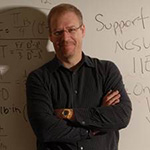 David Kaber is a Distinguished Professor of Industrial and Systems Engineering at North Carolina State University (NCSU) and an associate faculty member in the Biomedical Engineering and Psychology Departments. He is the Chair-elect for the Department of Industrial and Systems Engineering at the University of Florida. At NC State, Kaber has served as Director of Research for the Ergonomics Center of North Carolina and a NIOSH-sponsored Occupational Safety and Ergonomics education and research program. His current research interests include modeling and analysis of workload in unmanned systems operations, human performance and behavior in autonomous vehicle use, and design principles for automation transparency in human-in-the-loop systems. Kaber received his PhD from Texas Tech University in 1996. He is a fellow of the Institute of Industrial & Systems Engineers and fellow of the Human Factors & Ergonomics Society. He is a certified safety professional and certified human factors professional.
Instructors/Speakers
Prof. David Kaber
North Carolina State University (NCSU)
Date & Time
19 Jun 2018 (Tuesday) 11:30 – 12:30
Venue
E11-4045 (University of Macau)
Organized by
Department of Computer and Information Science