

-
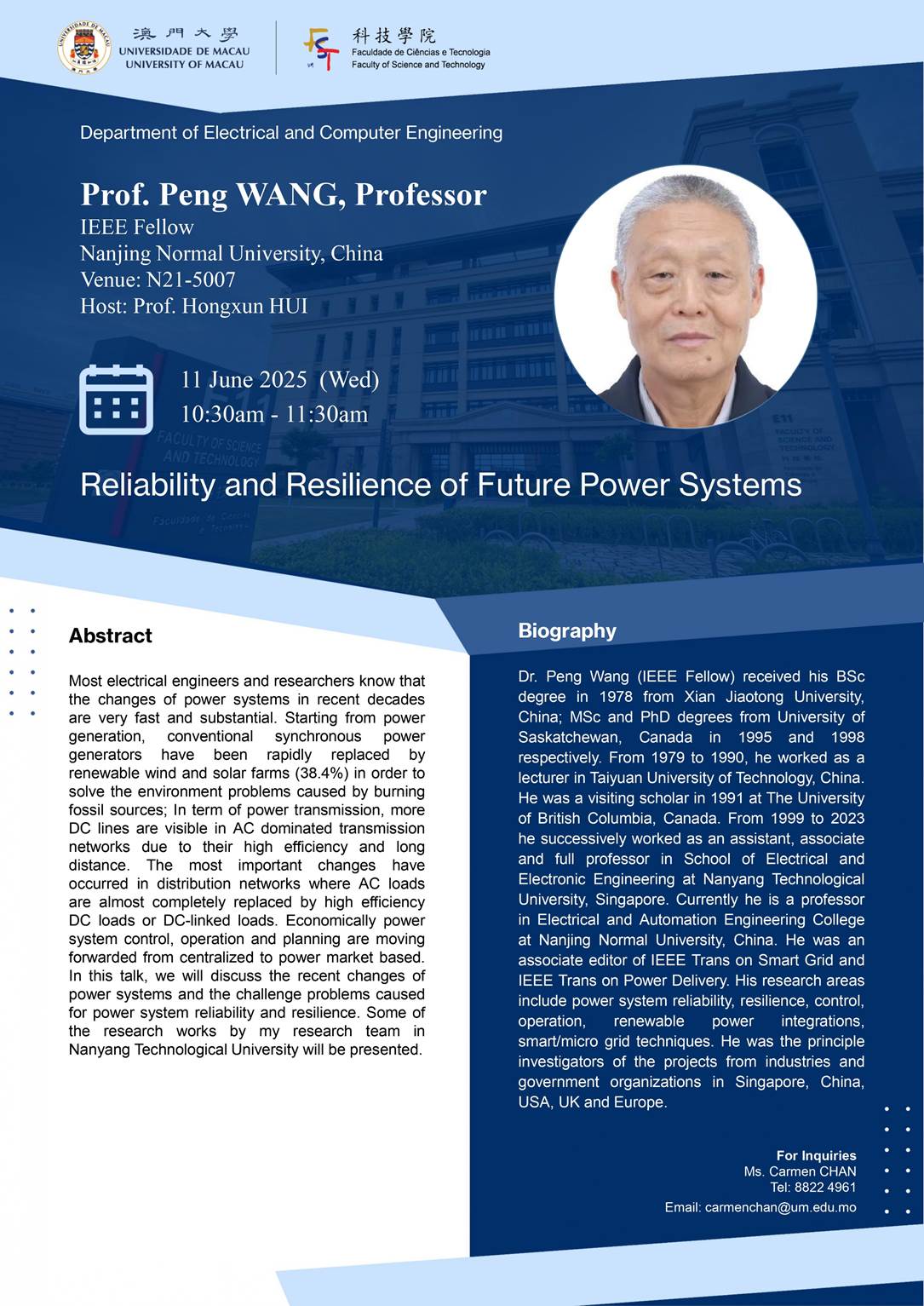
https://www.fst.um.edu.mo/wp-content/uploads/2025/06/20250611.jpg
|
M
Mon
|
T
Tue
|
W
Wed
|
T
Thu
|
F
Fri
|
S
Sat
|
S
Sun
|
|---|---|---|---|---|---|---|
|
0 events,
|
0 events,
|
0 events,
|
0 events,
|
0 events,
|
0 events,
|
0 events,
|
|
0 events,
|
0 events,
|
0 events,
|
0 events,
|
0 events,
|
0 events,
|
0 events,
|
|
0 events,
|
0 events,
|
1 event,
-
https://www.fst.um.edu.mo/wp-content/uploads/2025/06/20250611.jpg |
0 events,
|
0 events,
|
0 events,
|
0 events,
|
|
0 events,
|
0 events,
|
0 events,
|
0 events,
|
0 events,
|
0 events,
|
0 events,
|
|
1 event,
-
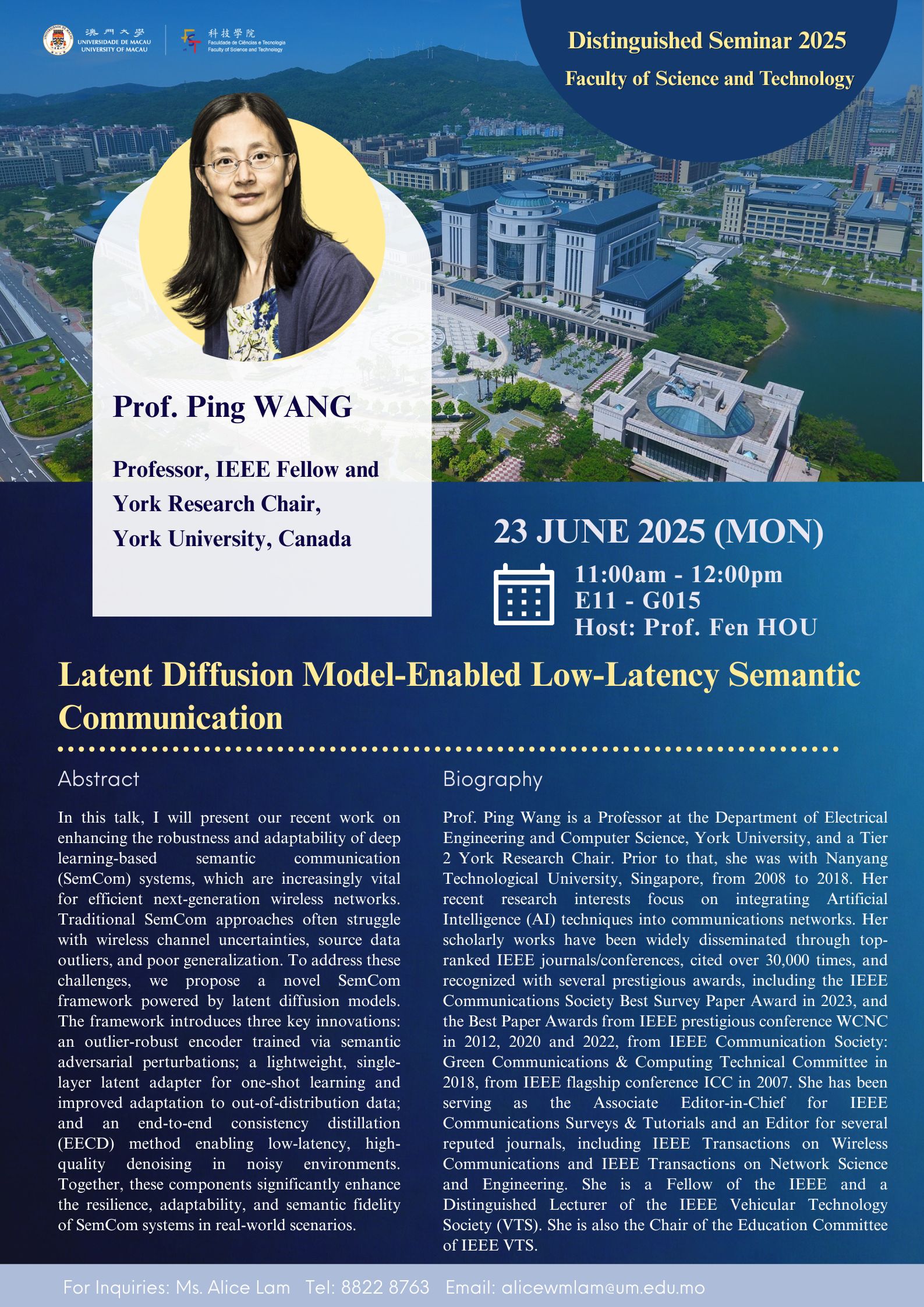
PHN0eWxlPgouZnVzaW9uLWNvbnRlbnQtYm94ZXMgLmZ1c2lvbi1jb2x1bW4gewoJbWFyZ2luLWJvdHRvbTogMHB4Owp9Cjwvc3R5bGU+ Faculty of Science and Technology of the University of Macau hosted a distinguished seminar titled "Latent Diffusion Model-Enabled Low-Latency Semantic Communication," presented by Prof. Ping Wang, Professor and IEEE Fellow from York University, Canada. The talk drew a diverse audience of numerous students from various departments, reflecting the growing interest in advanced communication technologies. Prof. Wang shared her cutting-edge research on enhancing the robustness and adaptability of deep learning-based semantic communication systems. She addressed challenges like wireless channel uncertainties and poor generalization, proposing a novel framework using latent diffusion models. Key innovations include an outlier-robust encoder, a single-layer latent adapter for one-shot learning, and an end-to-end consistency distillation method for denoising. The interactive Q&A session further enriched the learning ... |
0 events,
|
0 events,
|
0 events,
|
0 events,
|
0 events,
|
0 events,
|
|
0 events,
|
0 events,
|
0 events,
|
0 events,
|
0 events,
|
0 events,
|
0 events,
|