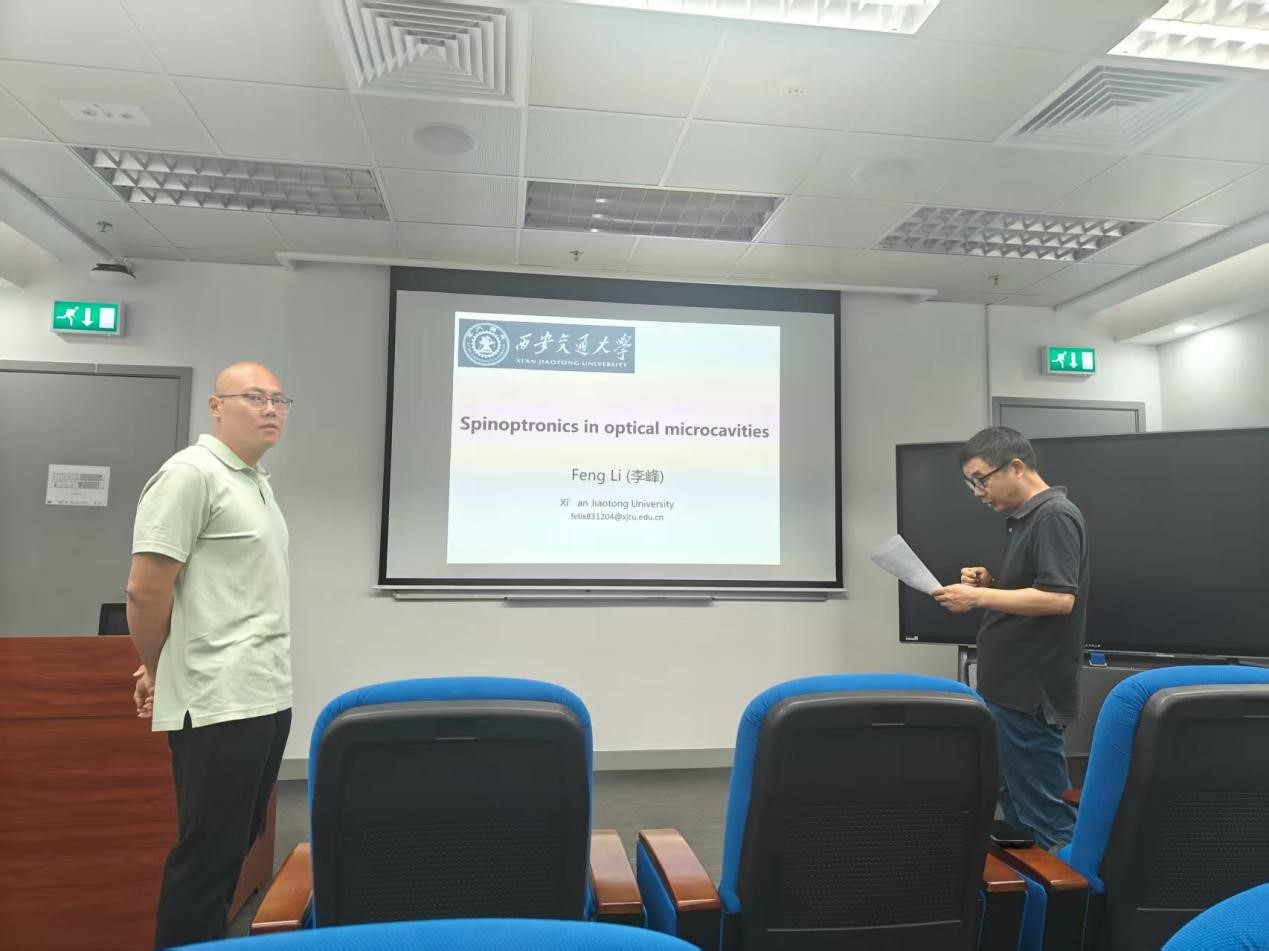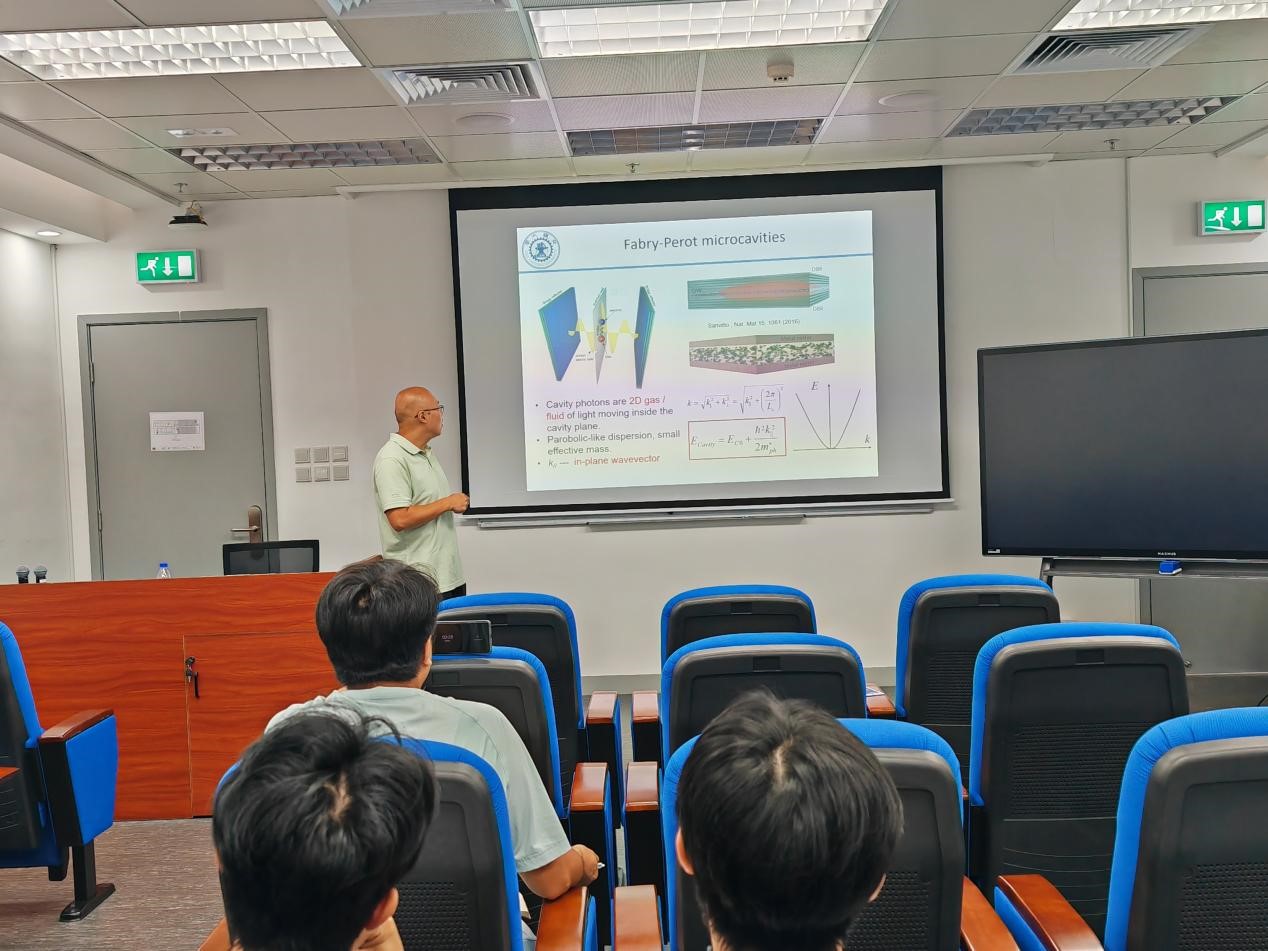
Prof. Feng LI from, School of Electronic Science and Engineering, Xi’an Jiaotong University, gave a talk entitled ‘Spinoptronics in Optical Microcavities’ at the Faculty of Science and Technology on 12 September, 2025.
At the seminar, Prof Li, shared his latest research results in the fields of microcavity optics and exciton polariton lasing. Fabry-Perrot (FP) microcavities with metal or DBR (distributed Bragg reflector)-coated mirrors provide an excellent platform for investigating the collective behavior of confined 2-dimensional photons and polaritons. The TE-TM mode splitting in such cavities acts as an effective magnetic field, leading to photonic spin-orbit (SO) coupling effect that the pseudospin of cavity photons changes anisotropically with their momenta. Such mechanism has led to interesting observations including optical spin-Hall effect, magnetic-monopole-like half solitons, spinor condensate with half-quantum circulation, and polaritonic topological insulators. Prof. Li presented the research of the direct measurement of the Berry curvature and quantum metric of the photonic modes of a FP cavity containing an anisotropic organic microcrystal (Perylene). Photonic spin-orbit-coupling induced by the cavity together with the anisotropy of the material results in the action of an effective gauge field on photons, which includes an effect of emergent optical activity (OA). The photonic gauge field makes emerge geometrically non-trivial bands containing two gapped Dirac cones with opposite topological charges. The same cavity structure with a DPAVBi microcrystal allows the observation of Voigt exceptional point at which the quantum metric is demonstrated to be divergent. He further report the observation of dual lasing of orthogonal polarization by polariton relaxation via the imaginary Fermi Arics. It is predicted that in fully confined systems the eigenstates of the second excited manifold under TE-TM splitting are degenerate skyrmions which can be manipulated by the non-Hermitian properties.