

In the microscopic world of the atomic scale, matter exhibits behaviours that challenge conventional understanding, revealing transport phenomena that are nothing short of extraordinary. Sun Pengzhan, assistant professor in the Institute of Applied Physics and Materials Engineering at the University of Macau (UM), has not only unravelled the scientific principles behind these phenomena, but also applied them to develop cutting-edge separation technologies. These innovations offer promising solutions to one of the biggest challenges in the energy sector: reducing energy consumption while improving efficiency. Prof Sun’s groundbreaking work earned him a spot on MIT Technology Review’s ‘35 Innovators Under 35’ list, recognising him as a rising star in Macao’s research community. From his early years at Tsinghua University to working under the mentorship of a Nobel laureate, Prof Sun’s journey has been driven by an unwavering passion for scientific discovery. He is deeply committed to exploring fundamental questions in science and paving the way for transformative applications in the future.
Unveiling the power of the invisible
In Prof Sun’s lab at UM, he and his team are often gathered around an electron microscope, their eyes fixed on a screen showing something almost invisible: a transparent membrane merely one atom thick. This is their groundbreaking creation—a novel ultra-thin proton-conducting membrane made with angstrom-porous titania. Inspired by his fascination with the subtle behaviour of proton transport, this innovation embodies Prof Sun’s belief that ‘breakthrough applications often grow from a deep understanding of fundamental scientific questions.’ This mindset drives his tireless exploration of microscopic spaces, where even the tiniest particles can unlock transformative technologies.
This ultra-thin membrane acts as an exceptionally precise and durable molecular sieve. It can selectively conduct protons at high temperatures while completely blocking other gases and ions—a breakthrough that overcomes the flaws of materials like graphene, which degrade under heat and have low conductivity. This innovation has led to a significant improvement in the performance of commercial proton membranes, achieving more than a tenfold increase in efficiency. It has also opened new possibilities for high-temperature fuel cell technology. Looking to the future, this advancement could revolutionise applications such as hydrogen-powered vehicles and decentralised energy systems, offering longer lifespans, better resilience to environmental challenges, and lower operational costs.
What is even more remarkable is that this membrane is not just a concept confined to the lab. Using a technique called ‘layer-by-layer electrostatic assembly’, the membrane can be produced at scale, making it ready for industrial use. Since joining UM in 2022, Prof Sun has guided his team through intense research and development, successfully overcoming bottlenecks. Their membrane now surpasses international standards for proton conductivity and offers a fresh perspective on the future of hydrogen fuel cell technology.
Where formulas meet curiosity
Prof Sun’s fascination with the microscopic world began during his undergraduate years at Tsinghua University. In 2008, he enrolled in the Department of Mechanical Engineering. In his second year, a pivotal moment came when he discovered the book Carbon Nanotubes by Prof Zhu Hongwei. This book opened the door to the captivating world of carbon nanomaterials and introduced him to a profound principle: structure determines properties. For Sun, it was a revelation. He realised that the true beauty of materials science was not in large-scale manufacturing, but in the invisible laws and equations that govern matter at the atomic level. ‘I wasn’t particularly drawn to mechanical design,’ Prof Sun recalls. ‘What fascinated me were the physical and chemical principles behind the formulas—the elegance of predicting how materials behave through fundamental principles and understanding the laws of nature at the atomic scale. It felt like art.’
This realisation prompted Sun to make a bold academic shift. For his doctoral studies, he transferred to the School of Materials Science and Engineering at Tsinghua, where he focused on the microscopic mechanisms of two-dimensional materials. This move was not just a change of major; it was a commitment to turning his curiosity into a lifelong pursuit. ‘Exploring these phenomena felt like solving an atomic-scale puzzle with an artistic touch,’ he says with a smile. ‘After final exams, I’d head straight to the lab. I didn’t even want to leave during holidays.’
In just eight years, Sun completed both his undergraduate and doctoral studies at Tsinghua. Reflecting on that time, he considers the clarity he gained about his research direction to be his most significant achievement. During his PhD studies, he focused on the separation mechanisms of graphene oxide membranes and noticed that existing explanations about microscopic transport pathways were often vague. This sparked his drive to think critically about established ideas and prompted him to investigate the inconsistencies he encountered. Eventually, Sun turned his attention to a fundamental question: how do different ions pass through graphene? Sun’s dedication to uncovering the underlying principles of material behaviour led him to the University of Manchester in 2016, where he studied under Nobel laureate Andre K. Geim. There, he embarked on a new chapter of his career, pioneering fresh approaches to the study of two-dimensional materials.
The sense of aesthetics in scientific inquiry
At the University of Manchester, Sun experienced a turning point in his scientific journey. ‘If your goal is just to publish papers, this isn’t the place for you,’ Prof Geim would often remind his students—a mantra that profoundly shaped Sun’s approach to research. It was a call to focus on the essence of scientific problems rather than chasing publishable results. Joining one of the world’s top research teams, Sun immediately felt the pressure. Surrounded by brilliant minds, he knew he had to prove himself. ‘I was very clear about one thing,’ he says. ‘I had to show what I was capable of.’
Then the pandemic hit. Forced out of the lab, Sun unexpectedly found opportunity in isolation. With time to focus, he immersed himself in analysing experimental data, uncovering subtle patterns that had previously gone unnoticed. His analysis led to a fresh interpretation of how gas molecules behave when transported through atomically thin two-dimensional channels. He compiled his insights and preliminary analysis into a report and sent it to Prof Geim.
The report sparked a series of intense, hours-long daily discussions between Sun and Prof Geim, ultimately leading to the formation of a research team that aimed to solve a critical challenge in gas separation using two-dimensional materials. Yet for Sun, the most profound outcome was not the publication; it was the development of a new kind of intuition: a sense of aesthetic judgment in science.
‘I learned to tell the difference between what’s truly important and what just seems popular,’ Prof Sun reflects. ‘That kind of instinct is like having taste in research.’ Inspired by the artistic philosophy of his favourite painter, Mu Xin, Sun came to believe that the pursuit of beauty and essence lies at the heart of original innovation. ‘Without that sense of aesthetics,’ he says, ‘even the most extensive knowledge might not be enough to guide you.’
MIT’s recognition: A reminder of the true value of research
Despite his rigorous training at Tsinghua University and the University of Manchester, Prof Sun faced a challenge common to many early-career researchers: attracting top students to a newly established lab. ‘No matter how refined your scientific taste is,’ he says, ‘you still need teammates to get the work done.’ This practical need inspired him to apply for the MIT Technology Review’s ‘35 Innovators Under 35’ list—not just for the honour, but to build visibility and attract young talent to join his team.
Renowned for its stringent selection process and focus on transformative technologies, the list was not something Prof Sun initially pursued with high expectations. ‘A friend suggested I apply, saying it’s a fast track to recognition in the academic world,’ he recalls. ‘I didn’t think much of it at first.’ But true innovation speaks for itself. Prof Sun’s pioneering discoveries on molecular transport in two-dimensional materials offered critical theoretical support for breakthroughs in clean energy, ultimately earning him a spot among the 35 Chinese honourees in 2023. Moreover, Prof Sun was the only recipient from Macao recognised that year.
The award brought increased attention and resources, but Prof Sun remained grounded. ‘MIT’s recognition is like a mirror. It reflects what real innovation should be,’ he says. For Prof Sun, the award was not about publication calculations, but about having the courage to challenge conventional frameworks—a philosophy deeply influenced by the ‘scientific taste’ he developed during his time in the UK. More than just an accolade, the experience opened unexpected doors. Through MIT’s cross-disciplinary exchanges, Prof Sun engaged in thought-provoking conversations with innovators from fields like artificial intelligence, biomedical engineering, and information science.
‘I realised the true value of the award isn’t the title—it’s the chance to exchange ideas with brilliant, unconventional minds,’ Prof Sun reflects. One of those conversations sparked a pivotal moment. During a discussion with a postdoctoral researcher working on brain-computer interfaces, Prof Sun was asked, ‘Why not apply your ion-selective membranes to neural signal transmission?’ That simple question ignited a new line of thinking and reshaped his vision for future research.
Today, at UM, Prof Sun leads a dynamic research team composed of young students and scholars. Together, they are exploring how ion transport mechanisms can be applied to neuromorphic devices, aiming to overcome the energy bottlenecks in traditional computing. ‘The true value of science isn’t found in the glow of awards,’ he concludes, ‘but in the enduring curiosity and drive to explore the unknown. Recognition is just one chapter in the journey. What truly matters is your ability to continue asking meaningful questions.’
‘Digging a riverbed’: A guiding research philosophy
Prof Sun often compares fundamental research to digging a riverbed: the aim is not to hasten the flow of water to the sea, but to ensure that the channel is deep, sturdy, and well-formed. This philosophy is reflected in his work on atomic-scale transport mechanisms, where he focuses on establishing solid scientific foundations that allow future breakthroughs to flow naturally. Such a long-term vision requires an environment that fosters intellectual freedom, and Prof Sun has found that at UM. ‘UM’s trust and openness allow researchers to navigate seamlessly between fundamental and applied science,’ he explains. ‘It gives us the space to follow our own research rhythm, explore new dimensions, and discover unexpected possibilities through interdisciplinary collaboration.’
Profile of Prof Sun Pengzhan
Prof Sun Pengzhan is assistant professor in the Institute of Applied Physics and Materials Engineering at the University of Macau. He earned his bachelor’s degree in Mechanical Engineering and Automation in 2012, and his PhD in Materials Science and Engineering in 2016, both from Tsinghua University. His research primarily focuses on the mechanisms and applications of molecular transport in strongly confined environments. In recent years, he has also focused on constructing nano- to sub-nanoscale confined channels with two-dimensional separation membranes, and investigating the selective transport behaviours of ions, atoms, and molecules. His research findings have been published in leading international journals, including Nature, Proceedings of the National Academy of Sciences, Nature Communications, and Science Advances. Prof Sun has received numerous prestigious honours, including the Excellent Young Scientists Fund (Hong Kong and Macao) from the National Natural Science Foundation of China, the Materials Research Society (MRS) Graduate Student Award, and Top Scholarship from Tsinghua University.
Source: My UM Issue 147
在微觀世界的原子尺度限域空間中,物質會展現出「奇特」的傳輸行為,澳門大學應用物理及材料工程研究院助理教授孫鵬展不僅揭開這一現象背後的科學原理,更將其轉化為高效的分離技術,為能源領域「高能耗、低效率」的困境開闢了全新的解決方案。憑這一卓越成就,他登上《麻省理工科技評論》「35歲以下科技創新35人」榜單,成為澳門科研界的一顆耀眼新星。從清華的求學歲月,到問道於諾貝爾獎得主門下,孫鵬展教授愈發專注於挑戰基礎科學難題,為未來實際應用奠定基石。
問道於微,佈局於遠
走進孫鵬展教授的實驗室,電子顯微鏡前總是聚集著他與團隊的身影,螢幕上那片僅有原子厚度的透明薄膜——他們開發的「新型超薄多孔質子交換膜」,是他們著迷於研究微小的質子傳輸現象的成果。「應用的種子,往往埋藏於對細微問題的深刻理解之中。」孫鵬展這句常掛在口邊的話,成為他深耕質子傳輸現象的動力。
這層透明薄膜,像是一面極致精密且堅韌的「分子篩」,能在高溫環境中精準篩選並傳導質子,又能完全阻隔其他氣體與離子,一舉解決了如石墨烯等材料在高溫下易失效、傳導效率低的痛點。而這項突破,不僅將商業質子膜的效能提升十倍以上,更為高溫燃料電池技術打開了新世界。未來,從氫能汽車到分散式能源系統,都有望因此擁有更長的壽命、更強的環境適應力與更低的運營成本。
更重要的是,這精密材料並非實驗室的「空中樓閣」,透過「逐層靜電組裝」技術,它可實現大規模製備,為通往工業化生產鋪平道路。2022年加盟澳大後,孫鵬展帶領團隊埋首研究,最終突破瓶頸,讓超薄質子交換膜的傳導效率超越國際標準,為氫燃料電池技術帶來全新思路。
著迷於公式背後的原理
對微觀機理的執著探索,始於孫鵬展在清華大學的求學歲月。2008年他考入清華大學機械工程系,大二時讀到朱宏偉教授所著的《碳納米管》,從此被碳納米材料的微觀世界深深吸引。書中揭示的「結構決定特性」原理,讓他意識到材料科學的魅力不在於宏觀製造,而在於微觀世界中公式與定律對材料本質的支配。「我對機械製造興趣不大,反而徹底著迷於公式背後的物理化學原理——那種通過基礎原理預測材料特性、從原子層面理解世界運行規律的美,如同藝術一樣令人興奮。」
這份熱愛,促使孫鵬展在博士階段選擇清華材料學院,聚焦於二維材料的微觀機理研究。對他而言,這不僅是專業的轉換,更是將興趣深化為學術方向的重要抉擇,期間樂趣無窮,「探索過程如同在原子級別的解謎遊戲中尋找藝術感。甚至「期末考一結束,我便會走進實驗室,連假期都捨不得離開。」孫鵬展笑說。
僅用了八年,孫鵬展便完成在清華的本科、博士生涯,他認為期間最大的收穫是清晰自己的科研追求。攻讀博士時研究氧化石墨烯薄膜分離機制,他發現文獻中對微觀傳輸途徑的解釋較為模糊。「盡信書不如無書」,他開始深入推敲「不同離子對石墨烯的穿透性」這一最基礎的問題。對底層邏輯的執著,最終引領他於2016年遠赴英國曼徹斯特大學,師從諾貝爾獎得主Andre K. Geim,開創二維材料研究的新方向。
科研的審美觀
在曼大的實驗室裡,孫鵬展經歷科研生涯的重要蛻變。「如果你只想發文章,那你不該來這裡。」Geim教授時常叮囑學生的一句話,反覆提醒他對問題本質的追求才是科學之道。初到實驗室時,他在頂尖團隊中倍感壓力,他需要在眾多優秀同儕間凸顯自身價值。「我清楚知道,我必須證明自己。」
疫情期間被迫暫離實驗室,為孫鵬展創造了一個契機,他專注梳理實驗數據,發掘出被忽略的規律,最終提出關於氣體分子在原子級别二維孔道中傳輸行為的全新解讀,並將其整理成報告與初步分析結果,寄給Geim教授。
Geim教授的回信,開啟了師徒二人每日數小時的深入討論,最後促成研究小組共同攻克二維材料氣體分離的關鍵難題。更重要的是,他在這段過程中培養出對科學問題的「審美」與判斷力。
「我學會區分甚麼是真正重要的問題,甚麼只是看起來熱門,」他說,「這種直覺,就像一種科研的品味。」他從喜歡的畫家木心對藝術的見解中得到啟發,深信對「美」與「本質」的追求,是原始創新的核心。「若缺乏這種審美,再多知識可能也拯救不了你。」
麻省理工的「試金石」
即便擁有清華與曼大的紮實訓練,孫鵬展仍須面對許多青年學者共同的現實挑戰:如何吸引優秀學生加入一個尚在起步階段的課題組?「再高的科學品味,也得先有隊員一起幹活才行啊。」他笑言。這促使他決定申請《麻省理工科技評論》的「35歲以下科技創新35人」——他不諱言其中帶有「擦亮招牌」、凝聚學生的考慮。
該榜單素以評審嚴苛、聚焦未來突破性科技聞名,而他卻對獲獎表現得格外淡然:「朋友推薦我申請,說這是讓學術圈認識你的快車道,我其實沒抱太大期待。」然而真金自會發光,他在二維材料分子傳輸機理方面的原創發現,為清潔能源領域的技術突破提供關鍵理論支撐,最終打動評審,不僅成為2023年度中國35人之一,更成為中國區獲選者中唯一的澳門代表。
獲獎為他帶來了更多資源與關注,但孫鵬展始終清醒。「MIT的榮譽就像一面鏡子,提醒你甚麼是真正的創新,」他強調,該獎項的評選標準並非論文數量,而是「是否敢於挑戰固有框架」——這正與他在英國培養的「科學品味」不謀而合。這份榮譽不僅是對他過去研究的肯定,更為他打開意想不到的科學視野。透過MIT組織的跨領域交流,他與來自人工智能、生物醫療、信息科學等領域的創新者深度對話。
「我意識到,這個獎的價值不是頭銜,而是讓你有機會和一群『怪才』互相碰撞,」他感慨道。在一場交流中,一位從事腦機接口的博士後向他提問:「為甚麼不將你的離子薄膜用於神經元信號傳導?」這句提問啟發了他,也重塑了他對研究框架的想像。
如今,他如願在澳大吸引一批年輕學子與學者,組建起研究團隊,正嘗試將離子傳輸機制拓展至神經形態器件領域,目標是打破傳統計算的能耗瓶頸。「科學的價值不在獎項光環,而在於對未知始終保有的好奇與探索,」他總結道,「獲獎只是插曲,重要的是你能否持續提出有價值的問題。」
「修河築基」的科研哲學
孫鵬展教授以「修建河道」比喻基礎研究:首重河道本身的深邃與堅固,而非急於看到水流歸海。他所深耕的原子級傳輸機制,便是這「修河築基」之舉。這份堅守,本身就需要自由的學術環境來滋養。正如孫教授所言,澳大的信任與包容,讓研究者可自由遊走於基礎與應用之間,遵循自身的科研節奏,為研究打開新維度,讓跨域融合看到新可能。
孫鵬展教授簡介
孫鵬展,應用物理及材料工程研究院助理教授,於2012年與2016年分別獲得清華大學機械工程及自動化學士學位、材料科學與工程博士學位。其研究聚焦於強限域環境中物質輸運的機理與應用,近年主要利用二維晶體構建納米至亞納米尺度限域通道,探索離子、原子與分子的選擇性輸運行為,相關成果發表於《自然》《美國國家科學院院刊》《自然通訊》《科學進展》(Science Advances)等國際頂尖期刊。他亦曾獲國家自然科學基金優秀青年科學基金項目(港澳)、美國材料研究學會研究生獎、清華大學特等獎學金等多項榮譽。
來源:《澳大人》第147期
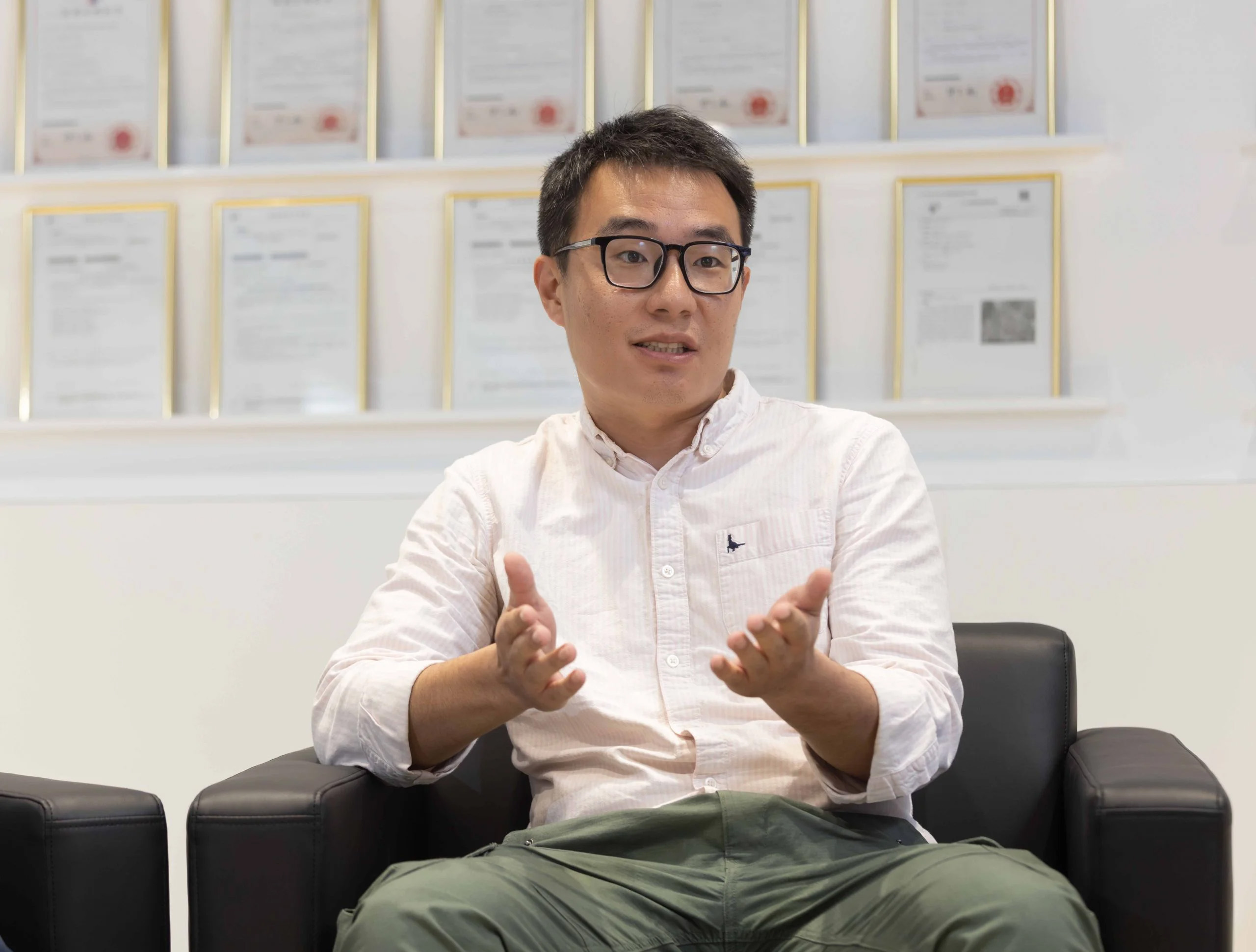
Prof Sun Pengzhan
孫鵬展教授
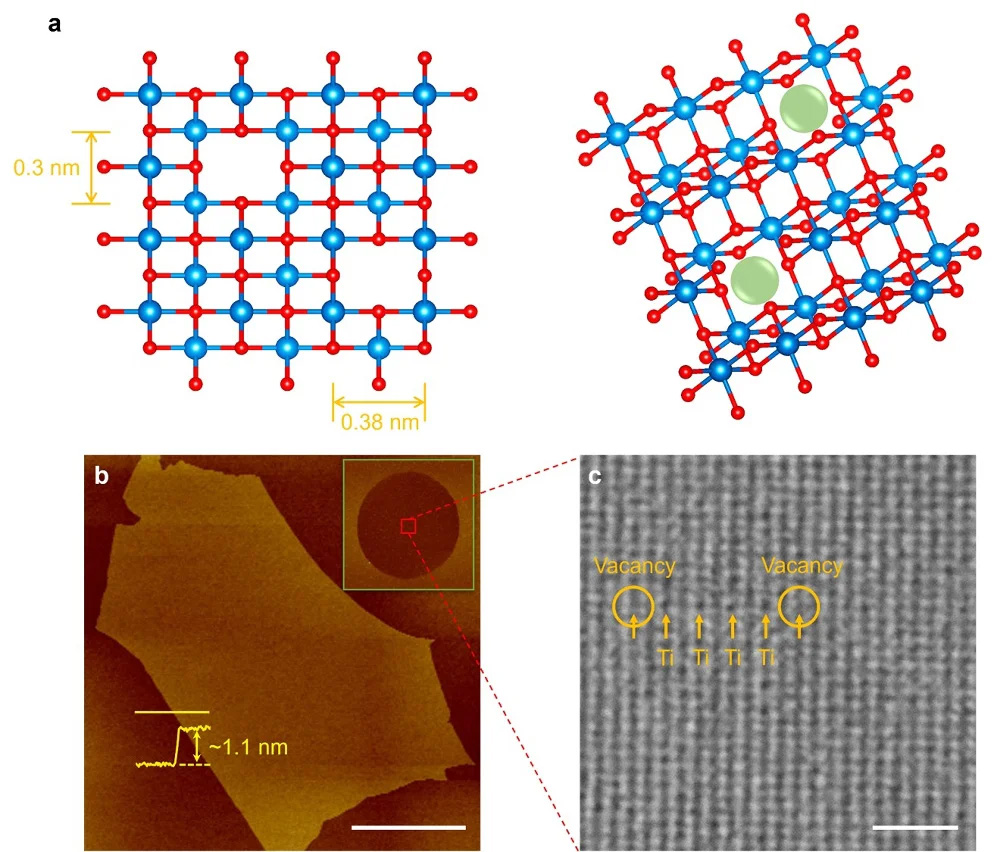
Prof Sun and his team have developed a novel ultra-thin proton-conducting membrane made with angstrom-porous titania
孫鵬展教授與團隊開發新型超薄多孔質子交換膜
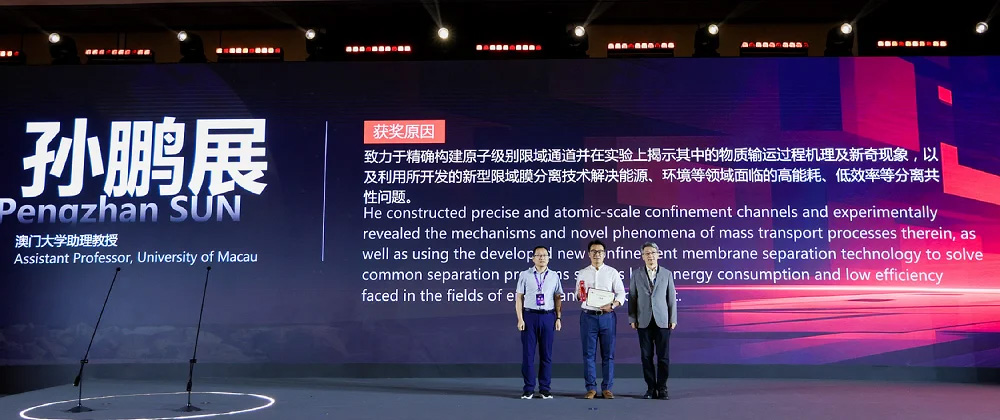
Prof Sun is named one of the '35 Innovators Under 35' by MIT Technology Review
孫鵬展教授登上《麻省理工科技評論》「35歲以下科技創新35人」榜單

Prof Sun describes MIT’s recognition as a mirror, reflecting what true innovation should be
孫鵬展教授:MIT的榮譽就像一面鏡子,提醒你甚麼是真正的創新
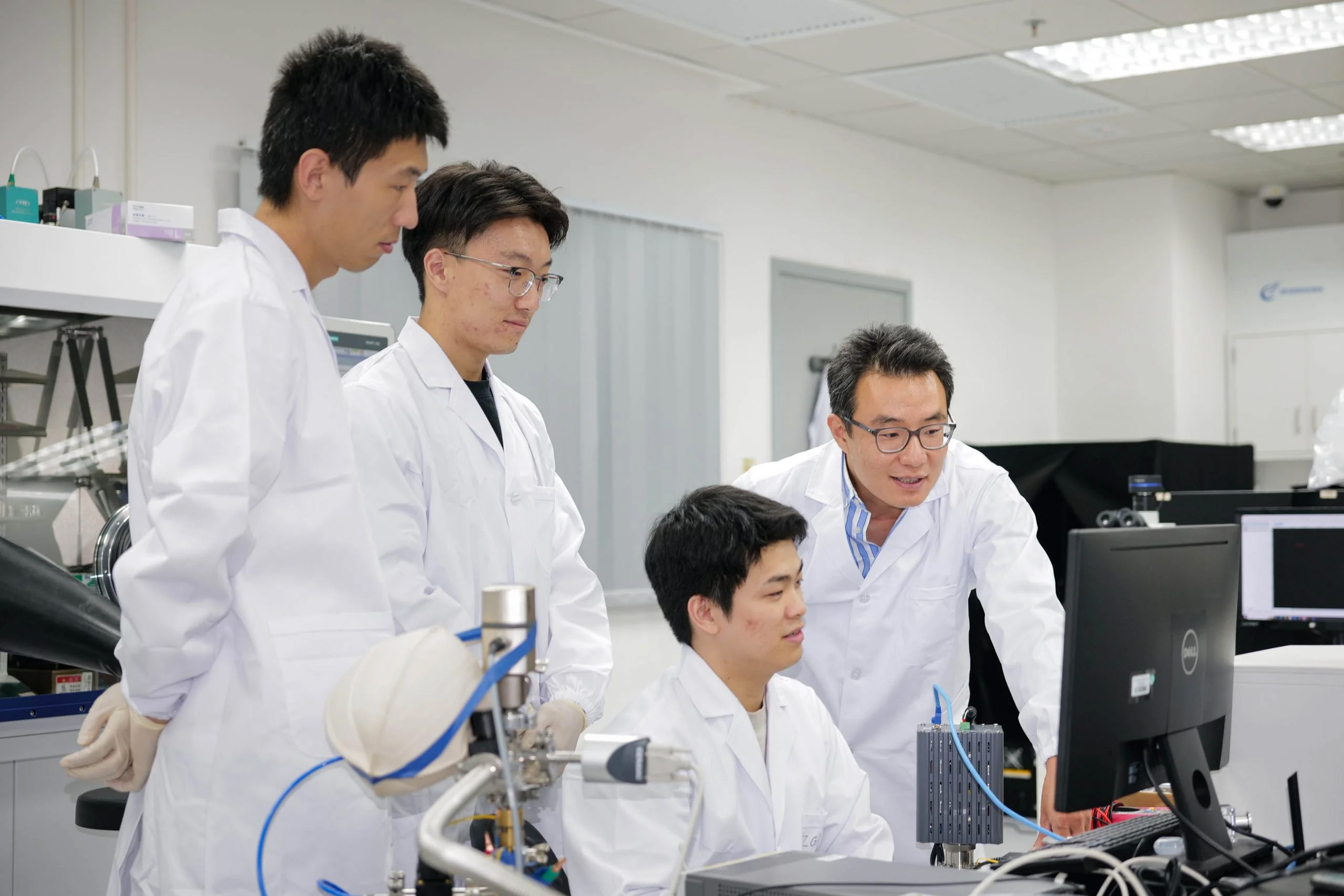
Prof Sun leads his team in interdisciplinary research
孫鵬展教授帶領團隊開展跨學科研究

Prof Sun has brought together a group of young scholars and researchers at UM to build a dynamic research team
孫鵬展教授在澳大吸引一批年輕學子與學者,組建起研究團隊