

| Location | E11-G032 |
| Academic Staff in charge | Prof. Kun Pang KOU; Prof. Chi Chiu LAM |
| Technician | Ka Man TOU; Ka In HOI |
| Telephone | (853) 8822-4279, 4122, 4287 |
Objective
The main objective of the structures laboratory is to demonstrate and investigate experimentally the behavior of structural elements. To properly illustrate the structural behavior, tests of structural members to destruction are conducted. Tests have been carried out for the determination of the plastic bending capacity of steel beams and the ultimate strength of steel tensile member and steel beam column connections in supporting courses. The laboratory is also equipped with facilities to conduct experimental research in the area of the structural engineering.
Facilities
Size and capacity of work area
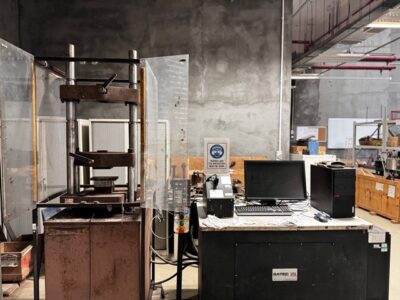
There are two work areas in the structures laboratory: (1) the Main Testing Area and (2) the Secondary Testing Area. The area of the main testing area is about 197 m2 (2140 ft2). It is a 2 cells RC box structure with 1000mm thick strong floor and tie down points on 600 mm x 600 mm grid. The design point load of each tie down points is 500 kN. A reaction strong wall of area about 48 m2 (2700 ft2) is located in the main testing area. It is a RC box structure with thickness of 1860mm and tie down points on 600 mm x 600 mm grid. The design point load of each tie down points is 250 kN. A three-dimensional 12.5-tone crane is installed in the main testing area. The area of the secondary testing area is about 155 m2 (1700 ft2) and several test machines such as the UTM and concrete compression test machines were located in this area.
Loading Frame
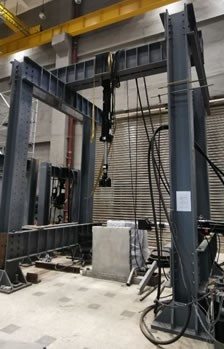
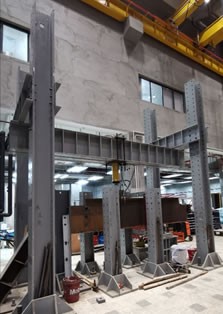
In the main testing area, there are self-equilibrium loading frames for structural members testing. Those loading frames are suitable for typical steel beam or RC beam tests. Holes are drilled in the columns of the frame to allow flexibility in the test setup. The frame can be modified to suit the testing of structural elements. With proper arrangement of the frame, the capacity of the frame can be achieved up to 1000 kN. Measurement of load, deflection and strain can be done by using a data acquisition system – Measurement Group System 5000. The system is connected through a personal computer that store and display the test data during testing.
 |
 |
Instrumentation and Heavy Equipment
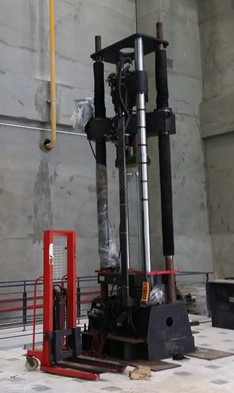
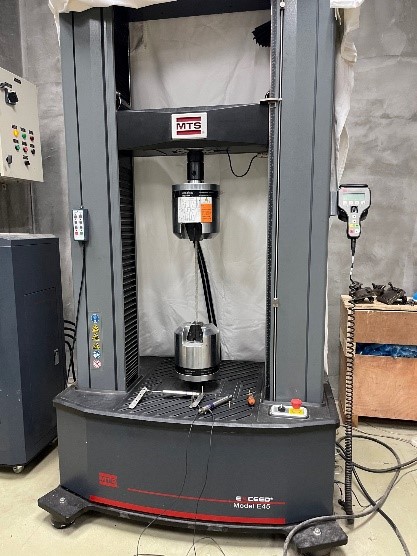
| Universal Testing Machines (2000 kN) | Universal Testing Machines (250 kN) | MTS Universal Testing Machines (100 kN) |
 |
 |
 |
|
Universal Testing Machines (UTM) applies for high-capacity tension, compression, bend/flex, and shear testing. Featuring a dual test space and long test stroke (300mm and 150mm), these frames are available in 2000kN (for bigger one) and 250kN (for smaller one) capacities. Testing Applications
|
||
Compression Machine (5000 kN)
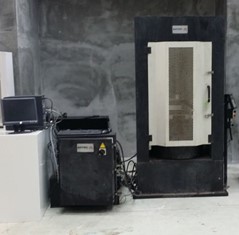 The compression machine is used for high capacity compression testing of concrete cylinders, cubes and block. For 5000kN capacity, it can cover most of general concrete testing.
Testing Applications
- Concrete—Cubes, Cylinders, Beams, Blocks and Bricks
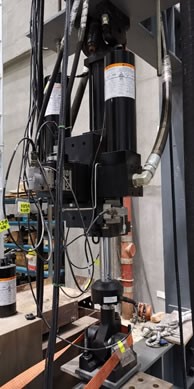
Hydraulic Actuator System
Actuator with 100kN capacity and 254mm stroke
Actuator with 250kN capacity and 500 mm stroke
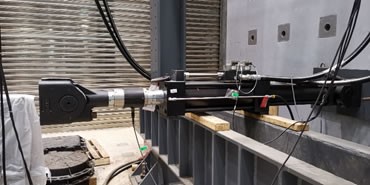
The actuator system is a component of the testing setup that is responsible for controlling the loading and displacement on the specimen testing.
Testing Applications
- Metals—Bar, Plate, Pipe & Tube, Rebar, Structural
- Wire—Rod, Strand
- Concrete / brick—Beam, wall
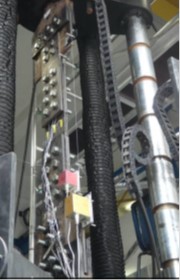
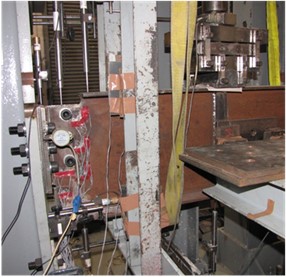
Some of the structural element tests were shown in the following figures.
| Steel bolted connection test | Steel beam connection test |
 |
 |
Apparatuses for testing the workability of fresh concrete
- Consistometer
- Compacting Factor apparatus
- Mould for Slump Test
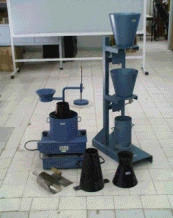
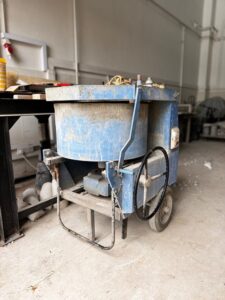
Mixer for the mixing of fresh concrete
Concrete compression and flexural test
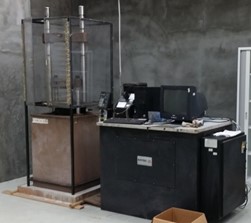
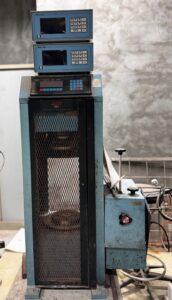
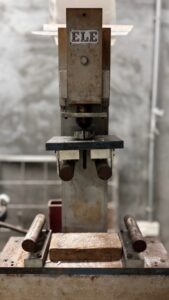
Compression and Flexure Testing Machine (ELE)
-
Compression Testing Machine (left): 2000 kN capacity capable of testing 200, 150 and 100 mm concrete cubes and cylinders up to 320 x 160 mm dia.
-
Flexural (Beams) Testing Machine (right): 100 kN capacity capable of testing
Steel coupon test
Experiments
- Testing Aggregates: Sampling, Shape, Size and Classification (BS 812)
- Testing Cement: Test for setting times (BS 4550)
- Making Concrete Mixes in the Laboratory (BS 1881)
- Method for making test cubes (BS 1881)
- Method for making test beams (BS 1881)
- Method for determination of slump (BS 1881)
- Method for determination of compacting factor (BS 1881)
- Method for determination of Vebe time (BS 1881)
- Method for determination of density of compacted fresh concrete (BS 1881)
- Method of normal curing of testing specimens (BS 1881)
- Method for determination of compressive strength of concrete cubes (BS 1881)
- Method for determination of surface hardness by rebound hammer (BS 1881)
- Method for determination of tensile splitting strength (BS 1881)
- Method for determination of flexural strength (BS 1881)
- Tensile testing of metallic materials (BS EN 10 002-1)
- Standard test method for time of setting of concrete mixtures by. penetration resistance (ASTM C403M)
- Standard test methods for bleeding of concrete (C232)
Courses supported
| CIVL2001 | Mechanics of Materials |
| CIVL2005 | Construction Materials |
| CIVL2006 | Structural Analysis |
| CIVL3000 | Steel Design |
| CIVL3004 | Reinforced Concrete Design |
| CIVL4000/4001 | Graduation Project I / II |