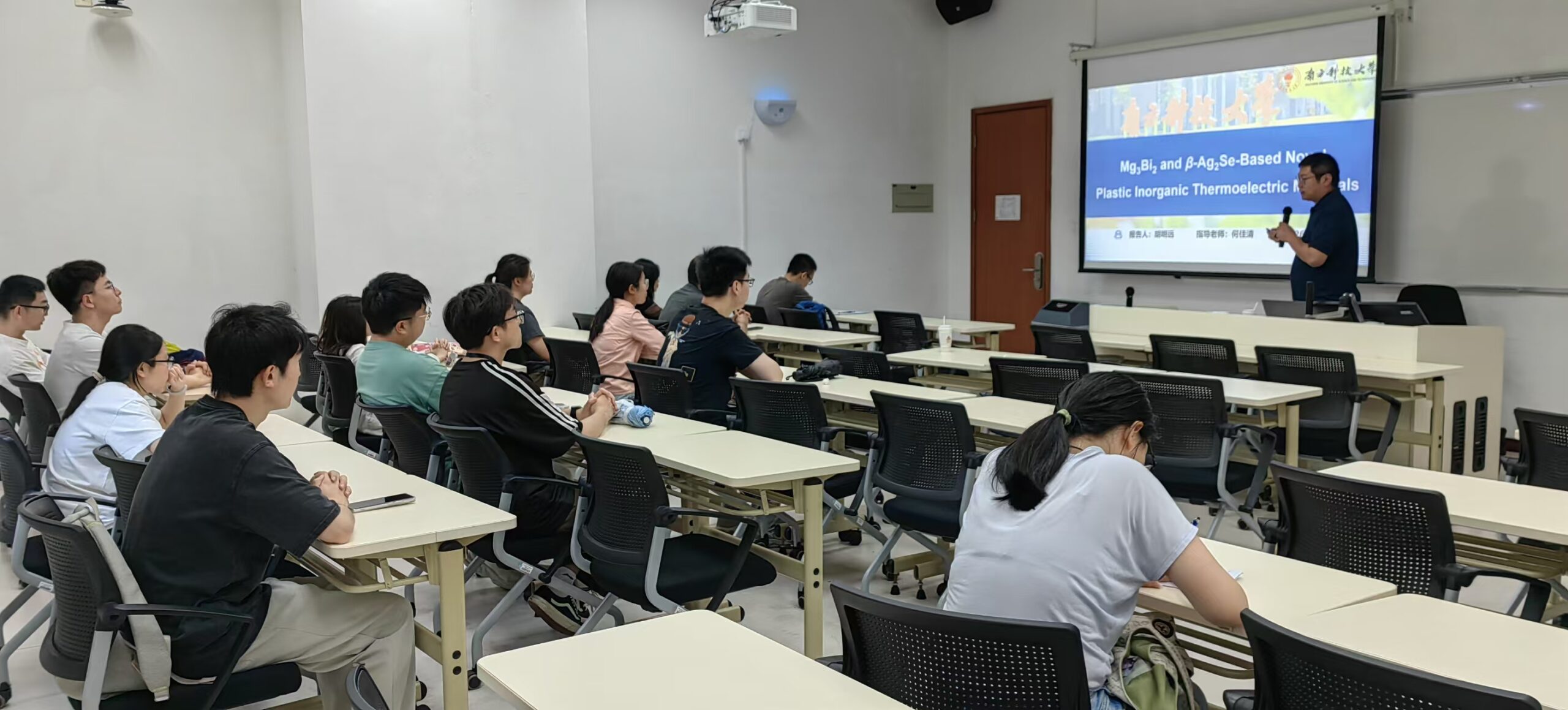
Dr. Mingyuan Hu from the Southern University of Science and Technology delivered a seminar entitled “Mg3Bi2 and β-Ag2Se-Based Novel Plastic Inorganic Thermoelectric Materials” at the Faculty of Science and Technology on 31 March 2026. The seminar introduced recent advances in the development of high-performance plastic inorganic thermoelectric materials and highlighted their promising potential for flexible electronic applications.
During the seminar, Dr. Hu presented his latest research on novel thermoelectric material systems based on Mg3Bi2 and β-Ag2S. He explained that plastic inorganic thermoelectric materials, which combine excellent thermoelectric performance with outstanding plastic deformability, are opening up new opportunities for the development of flexible electronic devices. He also pointed out that a major challenge in this field lies in developing plastic inorganic materials whose room-temperature thermoelectric performance can rival that of conventional brittle thermoelectric semiconductors.
Dr. Hu shared his team’s recent progress in addressing this challenge through the successful development of novel high-performance plastic inorganic thermoelectric materials. In particular, he highlighted that β-Ag2S single crystals exhibit a room-temperature thermoelectric figure of merit of 0.93, making them comparable to the most advanced plastic inorganic thermoelectric semiconductors reported to date. These findings demonstrate the strong potential of such materials for future flexible thermoelectric technologies.
In addition to presenting the performance of these materials, Dr. Hu also discussed the microscopic mechanisms underlying their plastic deformation. By integrating multiscale microscopic characterization, neutron scattering, density functional theory calculations, and molecular dynamics simulations, his research systematically revealed how structural characteristics contribute to both mechanical flexibility and thermoelectric properties. The work not only broadens the material system of plastic inorganic thermoelectrics but also provides valuable insights for the design and development of next-generation flexible energy materials.