

A research group led by Associate Professor Mo Huang in the Institute of Microelectronics (IME) at the University of Macau (UM) has been awarded the Outstanding Regular Paper Award at the 2025 IEEE Custom Integrated Circuits Conference (CICC) for their research on a continuously scalable-conversion-ratio switched-capacitor (SC) converter (CSCR) based on only four flying capacitors. Notably, it was the only paper to receive the Outstanding Regular Paper Award at the conference. The paper has also been invited for publication in the IEEE Journal of Solid-State Circuits (JSSC) and has been shortlisted for the ‘Top 10 Semiconductor Research Advances’ by the Journal of Semiconductors (English Edition). This marks the first time UM has received an Outstanding Regular Paper Award at CICC, reflecting the growing international recognition of the university’s research excellence in analogue and mixed-signal integrated circuits.
There is a pressing demand for high efficiency, high density power delivery in data centres. However, traditional inductor-based converters suffer from low power density, while switched-capacitor converters, though denser, struggle to maintain high efficiency across a wide voltage range. Intel’s previously proposed CSCR architecture requires over 30 capacitors, resulting in high costs and a strong reliance on advanced process technologies. Prof Huang and his research team have achieved a breakthrough with an ultra-compact hybrid CSCR architecture featuring three key innovations: (1) a front end switched-capacitor stage that clamps the flying capacitor voltage swing to one quarter of its original value, substantially reducing charge sharing losses; (2) a half-outphasing technique that sustains high efficiency across a wide conversion ratio range using only four flying capacitors; and (3) a stage outphasing technique that further optimises overall efficiency.
Measurements show peak efficiency of 92.5% and maximum single-phase output power of 1.52 W. Compared with Intel’s architecture, the new design reduces the number of flying capacitors by 70%, the number of switches by 80%, and the switch idle ratio by 50%, all achieved without relying on high-density on-chip capacitors. These improvements significantly lower process barriers and costs, and facilitate commercialisation. The research redefines the design methodology for CSCRs, breaking the conventional notion that high efficiency must come at the cost of high resource consumption. The proposed technology can be extended to 2.5D/3D advanced packaging and is particularly well suited for point-of-load power delivery in data centres and edge computing.
The corresponding author of the study is Prof Huang. The first author is Wang Yuanfei, a postdoctoral fellow in IME. The co-authors are Rui Martins, vice rector of UM and director of IME; and PhD student Zhang Zhiyuan and master’s student Zhong Ziyang in IME. Zhang Yihan, assistant professor in the School of Engineering at The Hong Kong University of Science and Technology, also contributed to the study. The research was funded by the Science and Technology Development Fund of the Macao SAR (Grant Nos.: 0041/2022/A1 and 004/2023/SKL). The full version of the research article is available at: https://ieeexplore.ieee.org/abstract/document/10983039.
Source: Institute of Microelectronics
澳門大學微電子研究院副教授黃沫帶領的研究團隊於2025年國際電機電子工程師學會(IEEE)定制集成電路大會(CICC)上提出一種僅基於四個飛電容的高效能連續轉換比開關電容電壓轉換器(CSCR),榮獲大會唯一最佳常規論文獎,獲邀於《IEEE Journal of Solid State Circuits》(JSSC)刊登,並入選《半導體學報(英文)》“半導體年度十大研究進展”候選。這是澳大團隊首獲CICC最佳論文獎,反映大學在模擬與混合信號集成電路領域的科研實力備受國際認可。
針對數據中心等場景對高效率、高密度供電的迫切需求,傳統電感型轉換器功率密度低,開關電容轉換器雖密度高,卻難以在寬電壓範圍內保持高效。Intel提出的CSCR架構需要超過30個電容,成本高昂且受先進工藝制約。黃沫及其研究團隊以極簡混合CSCR架構實現突破,通過三大技術創新:前置開關電容級可將飛電容電壓擺幅限制至原始值的1/4,顯著降低電荷共享損耗;半錯相控制技術在僅四個飛電容的條件下,於寬轉換比範圍內維持高效率;級間錯相技術則進一步優化整體效率。實測結果顯示,其峰值效率達92.5%,單相最大輸出功率1.52 W。與Intel架構相比,飛電容數量減少70%,開關數量減少80%,開關閒置率降低50%,且不依賴高密度片上電容,有效降低工藝門檻與成本,為商業化掃清障礙。
該研究重新定義了CSCR設計思路,打破了“高效必靠資源堆砌”的傳統思路。其技術可擴展至2.5D/3D先進封裝,尤其適用於數據中心、邊緣計算等近負載供電場景。
該研究通訊作者為黃沫,第一作者為澳大微電子研究院博士後王遠飛,共同作者為澳大副校長兼微電子研究院院長馬許願(Rui Martins)、澳大微電子研究院博士生張致遠與碩士生鍾子暘。香港科技大學工學院助理教授張奕涵亦為研究作出貢獻。該研究獲澳門特別行政區科學技術發展基金(檔案編號:0041/2022/A1和004/2023/SKL)資助。全文可瀏覽:https://ieeexplore.ieee.org/abstract/document/10983039。
新聞來源:微電子研究院
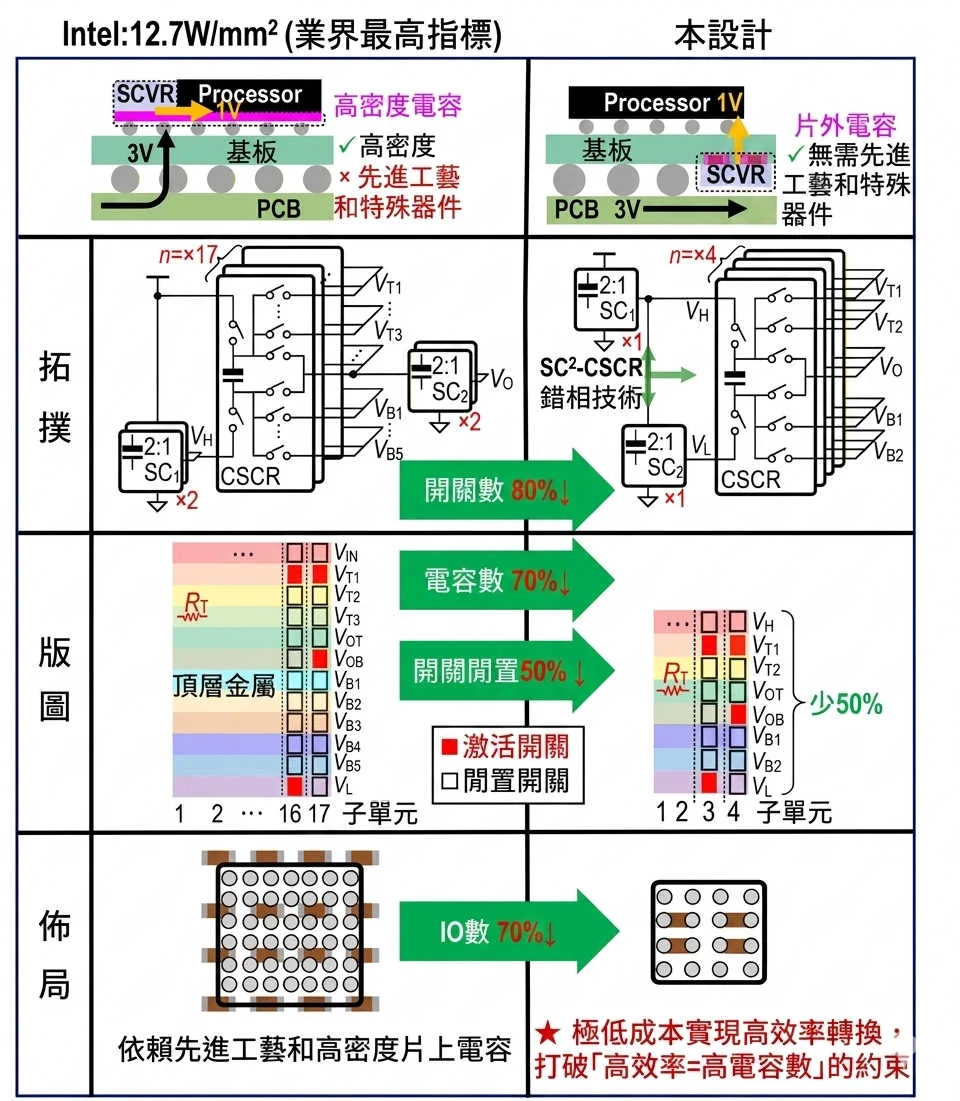
A comparison of the CSCR architectures proposed by UM and Intel in terms of topology, layout, and placement
該研究與Intel提出的架構從拓撲、版圖和佈局對比
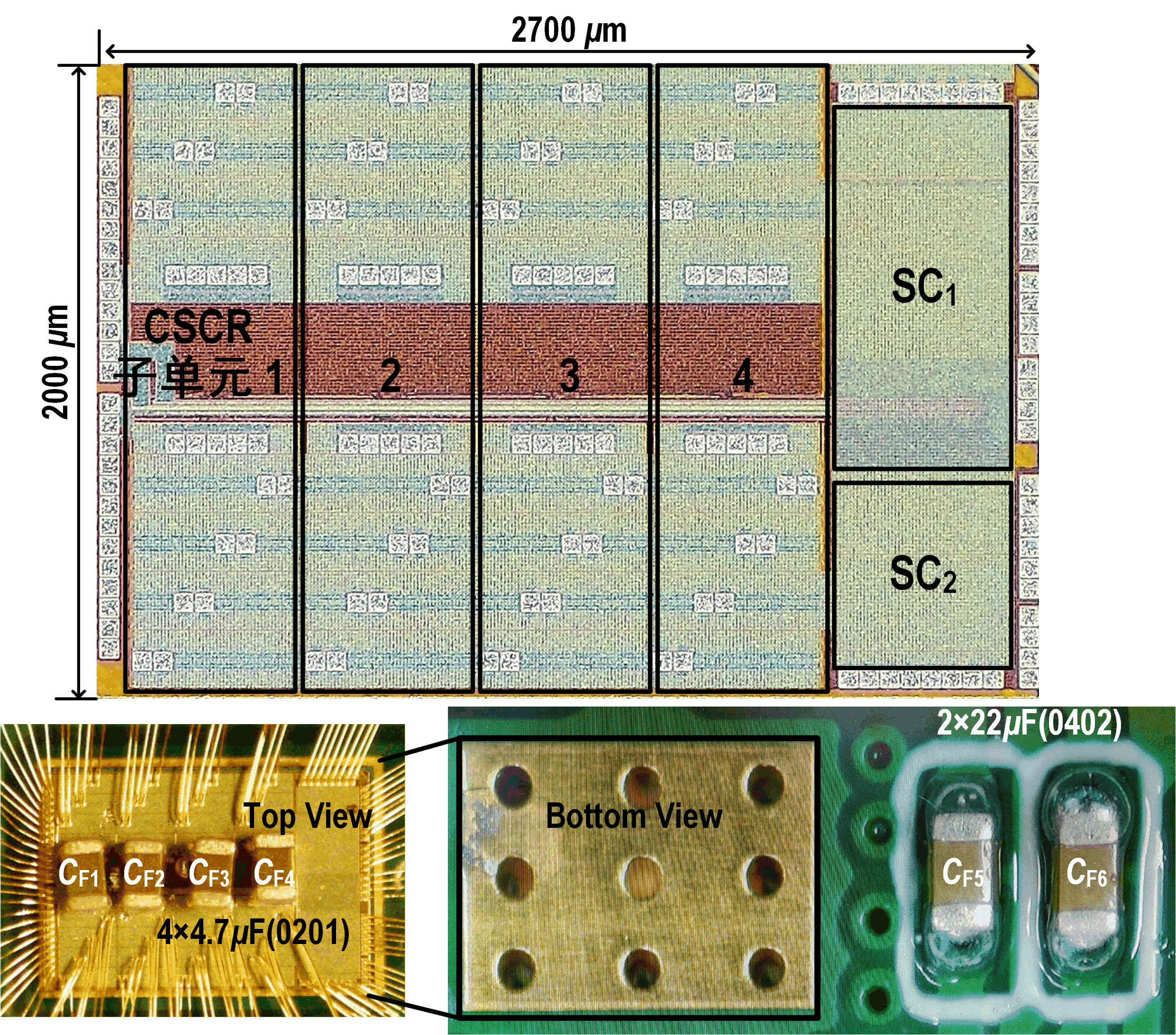
The chip and its packaging
芯片與封裝
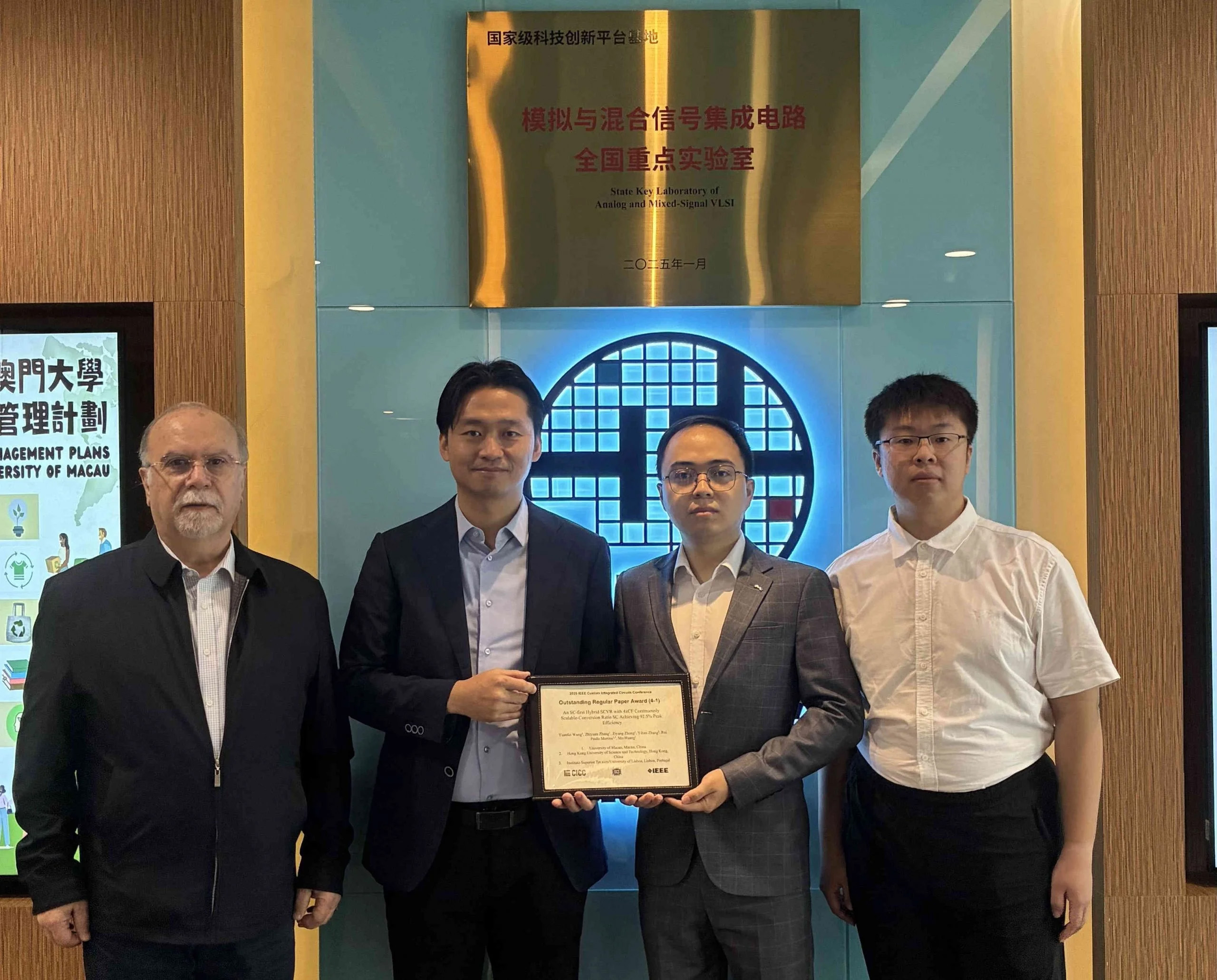
(From left) Rui Martins, Huang Mo, Wang Yuanfei, Zhang Zhiyuan
(左起)馬許願(Rui Martins)、黃沫、王遠飛、張致遠